
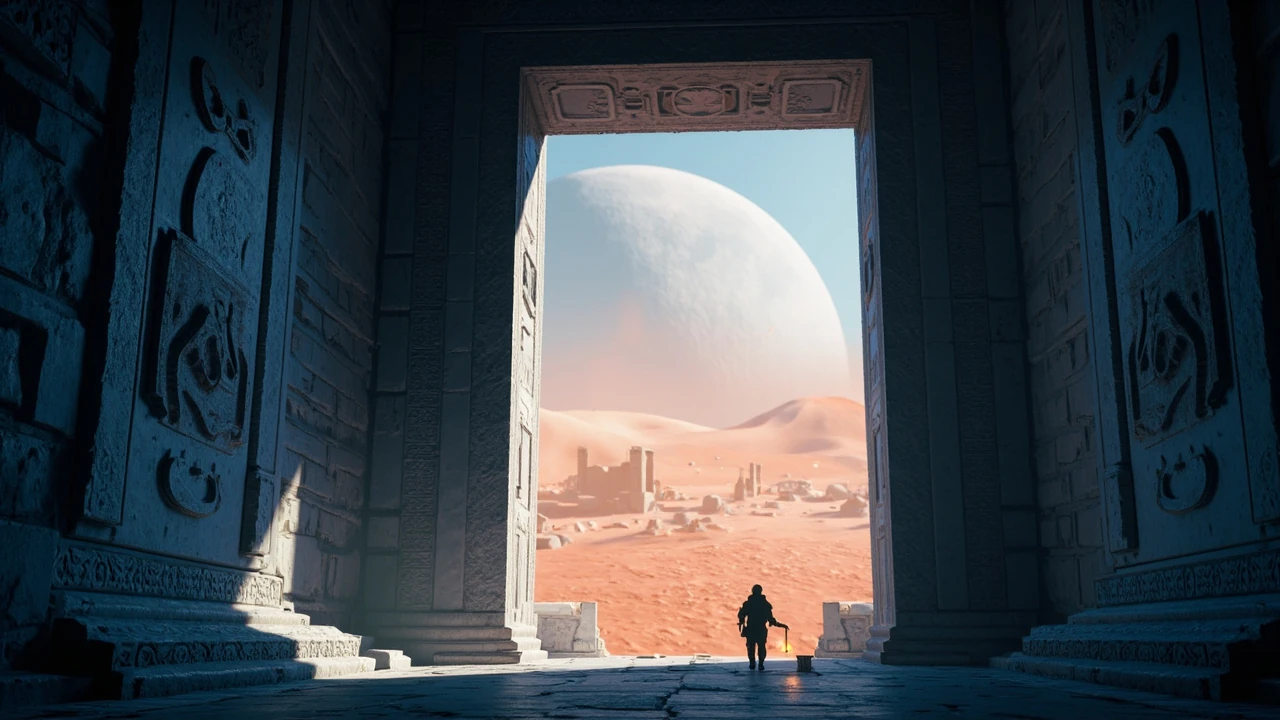

Azure moon labyrinth crimson desert: how two contrasting spaces shape an open world
A dungeon carved from pale blue stone under a permanent moon, opening onto a sun-baked plateau of red sand, is one of the most memorable transitions in modern open-world level design. Designers reach for this contrast because it solves several problems at once: it gives the player a clear environmental goal, a temperature shift that the body reads before the eyes do, and a reason to return to a hub that otherwise risks feeling flat. The azure moon labyrinth crimson desert pairing is not a single game, but a reusable design pattern that has been refined in different open-world projects, and the lessons from those projects apply directly to indie studios planning a vertical slice.
This article treats the azure moon labyrinth and the crimson desert as two connected design problems rather than two separate spaces. The labyrinth decides how a player enters a region, how the environment teaches mechanics in isolation, and what reward gates sit between exploration and combat. The desert decides how the world opens up, how resources and danger spread across distance, and how a hub city earns its weight. The bridge between them is where most studios either win or lose the player’s attention, and the bridge is mostly a question of camera, audio, and pacing rather than raw polygon count.
Throughout, the framing leans on publicly documented design language from recent open-world releases and the kind of vertical-slice decisions an indie team can actually make on a twelve to eighteen month production window. Where claims depend on a specific source, the link points to a verified reference. Where the topic requires editorial reasoning, that reasoning is flagged as such rather than dressed up as fact.
Why the cool-warm contrast works in level design
Players do not read environments as flat color fields. They read them as thermal, acoustic, and spatial shifts, and the brain locks onto a sudden change in any of those channels as a navigational cue. A pale, blue-lit stone corridor under a constant moon reads cool, enclosed, and quiet. A wide red plain under a low sun reads warm, exposed, and loud. The transition between the two is therefore a form of punctuation: a paragraph break, a chapter title, an audible inhale before the next phrase of music begins.
Designers exploit this in three concrete ways. First, it compresses the tutorial. A labyrinth with low enemy density and short sightlines is an ideal place to introduce a climbing, lockpicking, or stealth mechanic in relative safety. Second, it creates a natural save and load gate. The narrow throat at the labyrinth exit is a defensible place to drop a checkpoint without breaking the flow of the world. Third, it gives the cinematics team a setup and payoff: the player descends into cold stone with a small problem to solve, and the camera rises into warm light with a much larger world revealed.
The pattern is older than the games that get credit for it. Ancient architecture paired hypogea with courtyards for exactly the same reasons: contrast made ritual legible, and the shift itself became the point. The risk in modern games is to treat the pattern as cosmetic, to color the dungeon blue and the desert red and call it design. The mechanics inside each space have to support the contrast, and that is where most prototypes fall apart.
What the cool space is actually for
A blue-lit, moon-side labyrinth earns its place when it does at least two of the following: introduces a new traversal verb, isolates a narrative beat, or stores a reward that the wider world will not let the player grind for easily. A dungeon that only gates a chest at the end is a corridor, not a level, and corridors do not justify a custom environment. Studios that get the most out of a labyrinth use it to test the player’s understanding of a verb before the open world requires it. Puzzles use the verb. Combat introduces the verb’s counter. The exit cutscene explains why the verb matters for the next region.
Acoustic design is where the cool space does quiet work. Stone corridors support long reverb tails, low rumbles, and sparse sound effects without overwhelming the mix. That is why a labyrinth is the right place to drop a single wind instrument or a slow string line and let it carry the section. Audio engineers can read the geometry of a hallway and predict the decay within a small margin, which is much harder in an open plain.
What the warm space is actually for
A red desert earns its place when it offers the player a reason to move across distance. That reason is usually one of three: a visible landmark that promises a reward, a resource node that respawns on a route, or a hostile faction whose territory the player must cross to reach something else. The desert is rarely about combat alone. Combat scales with distance in a desert in a way that is hard to balance, and a desert without a clear reason to traverse it turns into a loading screen the player resents.
The open world’s job is to make the player’s effort feel like a choice. A red desert that punishes the player for walking one extra screen is a deterrent, not a world. A red desert that rewards the player for walking one extra screen, with a viewpoint, a rare material, or a lore fragment, is a world. The azure moon labyrinth primes the player to expect that reward by teaching the verb in a low-risk space, and the desert tests whether the player remembered it.
Mapping the pattern onto a vertical slice
Indie studios working on a vertical slice usually cannot afford both a fully modeled labyrinth and a fully modeled desert. The realistic budget for a slice is one tight dungeon, one wide vista, and one bridge between them. The bridge is the highest leverage area in the slice, and it is also the cheapest to iterate on. Three decisions deserve real time before the team commits art budget.
- Where the player first sees the open world from inside the dungeon, and what is framed in that shot.
- How long the player walks from the dungeon exit to the first real encounter in the desert.
- What the player’s inventory looks like at the moment the camera opens up, and what they can lose if they die in the first five minutes of the new space.
Each of those decisions is a design document, not a tech task. The first is a camera and lighting brief. The second is a pacing curve. The third is a tutorial, economy, and difficulty spike decision rolled into one. Teams that answer all three before the slice enters blockmesh tend to ship a coherent vertical slice. Teams that answer them in QA tend to ship a vertical slice that explains itself in a meeting instead of in gameplay.
Player guidance and traversal verbs across the bridge
The verbs the player learns in the dungeon must still be relevant on the other side. If the dungeon teaches a wall-run and the desert has no walls worth running, the verb dies in transit. Designers can keep a verb alive across the bridge in three ways: a tiny standalone puzzle at the exit, a skippable but rewarding side path that uses the verb, and a first encounter in the open world that quietly depends on it.
| Bridge decision | What the player learns | Risk if skipped | Cheapest validation |
|---|---|---|---|
| Skippable wall-run shortcut at the dungeon exit | The verb works in the open air, not just indoors | Players never use the verb in the open world | Watch a playtester ignore the shortcut and add a signpost |
| Resource node that requires the verb on a nearby cliff | The verb has economic value, not just traversal value | Players treat the verb as optional flavor | Check whether the node is the fastest path to a basic material |
| First enemy encounter that punishes not using the verb | The verb is required, not decorative | Combat players skip traversal and complain the world is empty | Compare time-to-kill with and without the verb |
The cheapest validation on a vertical slice is a single twenty-minute playtest with a designer watching, not playing. The point of the test is not whether the player finishes the bridge. The point is whether the player talks about the bridge afterward. If the player does not mention the transition, the contrast did not register, and the design document needs a clearer frame.
Acoustic and lighting design across the two spaces
Sound and light are the two channels that survive the move from a confined dungeon to a wide plain with the least retuning. A stone corridor is a reverb preset, and a red desert is a wind preset, and the audio team can swap between them with a single mix bus. The interesting work happens at the boundary, where the corridor meets the open air. A well-designed boundary has a three-step acoustic plan.
- The corridor ends in a low ambient hum that drops in volume by about 6 dB over the last ten meters.
- The threshold itself adds a short, dry slap of wind to suggest open sky before the wind layer takes over.
- The first thirty meters of the desert crossfade the corridor reverb into the wind preset, with a low cello line emerging to replace the dungeon motif.
Lighting works on a similar three-step plan. The corridor holds a constant cool key, the threshold opens a warm rim light that catches the player’s silhouette, and the first open vista adds a long, soft fill from the horizon. The technical artists can build all of this with one skybox swap, one volumetric fog volume, and one additional light probe at the threshold. The cost is small, the readability is high, and the effect carries a screenshot, a streaming thumbnail, and a launch trailer without extra production.
Color script as a real production tool
A color script is a series of reference frames that describe the emotional arc of a campaign in terms of palette and key light. The azure moon labyrinth crimson desert pattern is unusually friendly to a color script because the palette shift is binary. A team that writes the color script before the art bible usually discovers two things: the dungeon needs about three sub-palettes rather than one, and the desert needs at least two time-of-day passes. Both are easier to budget at the color script stage than at the blockmesh stage.
Hub city and back-loading: the desert as a recurring reward
An open world without a hub is a museum. The desert earns its value as a space to return to when it leads back to a hub that the player cares about. A hub can be a literal city, a camp, a caravanserai, or a single NPC at a crossroads. The shape matters less than the contract: when the player arrives at the hub, something specific changes. A vendor opens, a quest chain advances, a faction reputation ticks over, or a crafting tier unlocks.
The azure moon labyrinth primes the player for the hub by teaching one new verb per visit, and the desert carries the verb out into the world. On the return trip, the verb is the price of entry. A clean implementation looks like this: the player has to wall-run, grapple, or stealth past a checkpoint to re-enter the hub area, and the checkpoint is visible from the road. Players who cannot pass the checkpoint know exactly what verb to practice. Players who can pass it feel the change in status without a single line of dialogue.
| Hub design choice | Player reading | When to use it | Cost in a vertical slice |
|---|---|---|---|
| Vendor gated behind a verb checkpoint | The verb has economic weight | After the player has had two full runs in the open world | One NPC, one vendor table, one checkpoint prop |
| Quest giver in a hard-to-reach rooftop | The world rewards curiosity | After the player has found three other rooftops | One NPC, one cinematic, one path |
| Crafting tier unlocked by a dungeon clear | The dungeon is a progression gate | When the open world is wide enough to need a reason to return | One UI screen, one animation |
| Faction reputation that shifts on hub entry | The hub is contested ground | When the open world has more than one faction | One tracker, one bar, one script |
The cost column is the important one for a vertical slice. Each row maps to a real production cost in the order of days, not weeks. The reason to flag them is not to suggest that any team can build all four. The reason is that one of them, chosen deliberately, will define the entire identity of the hub. A vendor-gated hub is a different game from a faction-gated hub, and a vertical slice has to pick.
Open-world pacing: when to give the player a moment
An open world that never slows down turns into a checklist. The azure moon labyrinth crimson desert pattern helps with pacing because the dungeon is a built-in breather. After a long ride across the desert, the player is naturally inclined to enter the cool, quiet space and stay for a few minutes. Designers can reward that stay with a small story beat, a save room, or a craft bench, and the player reads it as breathing room rather than downtime.
The pacing curve for a five-hour campaign that uses this pattern often looks like a sawtooth: open world rise, dungeon dip, open world rise, dungeon dip, climax in one or the other. The dip is the labyrinth. The rise is the desert. The teeth of the sawtooth are the bridge between them. Studios that build the bridge as a real space rather than a loading screen tend to retain players through the late game, because the bridge becomes its own small ritual.
- Breather dungeons should not introduce new combat verbs. Combat is loud. Breathers are quiet.
- Hub visits should never be required twice in a row. A forced back-to-back hub trip feels like a tax.
- The first return to a previously cleared dungeon should change something inside it. A door is open, an enemy is gone, or a vendor has moved in. The world has to feel like it remembers the player.
These are not rules. They are observations from published level design postmortems, and they are useful as a starting checklist. A studio with a strong narrative lead can break any of them if the story demands it. A studio without that lead should treat the checklist as a guardrail, not a suggestion.
Designing the bridge as a real space
The bridge is the highest leverage area in the entire azure moon labyrinth crimson desert pattern, and it is also the area most often faked. A common shortcut is a cutscene and a loading screen. The shortcut is cheap, and the player feels the cheapness. A better approach is to make the bridge a walkable path with three deliberate beats.
- Beat one: the player exits the dungeon into a transitional space with a wide camera. The player stops moving for a few seconds without being asked to.
- Beat two: the player crosses a threshold where the audio preset changes, the wind starts, and the skybox swaps. The change is noticeable but not flagged by a popup.
- Beat three: the player enters the open desert and reaches a waypoint within sixty seconds. The waypoint offers a fast travel unlock, a vendor, or a quest marker, so the player’s effort is immediately rewarded.
The reason three beats work is that the player’s attention is naturally low during a transition. Designers can place subtle information in that window without interrupting flow: a distant landmark, a faction banner, a smoke trail, a sound cue. The player will not process the information in detail, but they will encode it as a sense of “the world has more in it than I have seen.” That encoding is what makes an open world feel large without being large.
Combat density and encounter design across the two biomes
Combat in a confined dungeon and combat in an open desert are not the same design problem. In a dungeon, combat is a closed encounter. Walls, sightlines, and chokepoints define the shape of every fight. In an open desert, combat is a distributed system. The player can be approached from any angle, and the encounter shape depends on terrain, weather, and the player’s own route choice. A team that ports the dungeon’s encounter logic into the desert will produce a desert that feels like a corridor with a skybox.
A common solution is to separate combat verbs by biome. The dungeon teaches a short-range, parry-heavy combat style. The desert teaches a long-range, mobility-heavy combat style. The player’s loadout changes as they cross the bridge, and the change is visible in the equipment menu. The trade-off is real: the player cannot bring a parry build to a desert encounter without paying for the privilege in weight, stamina, or weapon degradation.
| Biome | Combat identity | Encounter shape | Failure state the player can recover from |
|---|---|---|---|
| Azure moon labyrinth | Close range, parry, verticality | Chokepoint, two to four enemies, scripted elites | Lose a small amount of currency, retry at the checkpoint |
| Crimson desert (open world) | Long range, mobility, kiting | Squad approach from multiple angles, terrain-dependent spawns | Lose a fraction of carried resources, fast travel back to the hub |
| Bridge | Single threat, scripted chase or escape | One or two enemies, environmental hazards | Forced reset to the dungeon exit, no resource loss |
The third row, the bridge, is the one most often skipped. A team that adds a single scripted encounter to the bridge gains a free tutorial for open-world combat. The encounter is short, the failure is cheap, and the player learns how the desert’s combat feels before they commit to a real engagement. The cost is one animation, one enemy, and one trigger volume.
Economy and resource flow across the bridge
Resource design is the unglamorous backbone of an open world. The azure moon labyrinth crimson desert pattern helps because the two spaces produce different resources. The dungeon produces a slow, high-value resource: rare crafting materials, lore items, or a single-use key. The desert produces a fast, low-value resource: ammunition, food, healing items, or trade goods. The player’s inventory moves from the dungeon’s economy to the desert’s economy in the first few minutes of the bridge, and that movement is a real design lever.
A team that wants the bridge to feel like a gear check can ask the player to spend a high-value resource at the threshold, in exchange for a fast travel unlock, a vendor discount, or a faction reputation tick. A team that wants the bridge to feel like freedom can give the player a small gift at the threshold, with a tooltip that explains how to use it. Both are valid, and the choice defines the entire emotional shape of the campaign’s first hour.
- High-value resources from the dungeon should never be purchasable from a desert vendor. The dungeon must remain the only reliable source.
- Low-value resources from the desert should respawn on a timer, so the player’s travel time is always a small investment with a small return.
- The bridge should not introduce a third resource type. Two is enough for a vertical slice. Three is a tech debt burden.
Vertical slice scope: what to cut, what to keep
A vertical slice has to be honest. It has to show the player the core loop in a small space, without faking the open world or faking the dungeon. The azure moon labyrinth crimson desert pattern helps because it gives the team a clear answer to “what is the core loop”: enter the dungeon, learn a verb, exit to the desert, use the verb to reach the hub, return to the dungeon with a new verb. That loop fits in twenty minutes of gameplay and demonstrates the entire game’s shape.
What to cut, in order of cost-effectiveness:
- Cut any feature that does not appear in the twenty-minute loop. Side quests, collectibles, and a second dungeon can wait for vertical slice two.
- Cut any cinematics that explain what the bridge already shows. The camera rise from the dungeon to the desert is a cinematic by itself.
- Cut any tutorial popup that explains a verb the dungeon just taught. Trust the player.
- Cut any vendor inventory that the loop does not need. One weapon, one armor set, one consumable is enough.
What to keep, in order of leverage:
- Keep the audio mix across the bridge. It is the cheapest part of the slice to make feel premium.
- Keep the camera framing of the first desert vista. It is the screenshot that sells the slice.
- Keep the hub visit. It is the only place where the player sees the economy in action.
- Keep the loss state on death. It is the only feedback the player gets that the world has weight.
Common failure modes in the pattern
The azure moon labyrinth crimson desert pattern is robust, but it has well-known failure modes. A team that recognises the failure modes early can avoid them with small decisions rather than large rewrites. The list below is not exhaustive, but it covers the cases that show up in published postmortems and the kind of playtest notes that arrive after the first external build.
- Dungeon is too long for its reward. If the labyrinth takes more than twenty minutes to clear and the player receives only a small inventory item, the contract breaks. A dungeon that takes a long time has to return either a new verb, a major story beat, or a permanent progression unlock. Pick one.
- Desert is too empty for its size. A wide plain with five landmarks reads as a wide plain with five landmarks. The desert needs at least one encounter per visible landmark, with the encounter density rising as the player approaches the hub.
- Bridge is a cutscene. A loading screen or a hard cut removes the player’s agency at the most readable moment in the campaign. Replace the cutscene with a short walk, a single scripted encounter, or a vista with one environmental interaction.
- Hub has no purpose. A hub that the player visits and leaves in two minutes is a tax. The hub needs at least one verb, one vendor, and one quest marker that does not exist anywhere else in the world.
- Color contrast is the only contrast. Blue and red are easy to paint, but the spaces need different acoustics, different enemy vocabulary, and different pacing. A team that only changes the palette has built a reskin, not a biome.
Each of these failure modes is fixable in a vertical slice. None of them are fixable in a launch patch without rewriting a level, a UI screen, or a system. The earlier the team sees the failure mode in a playtest, the cheaper the fix.
Validating the slice before showing it
A vertical slice is a promise. The promise is that the rest of the game will feel like this. Validating the slice is therefore not about checking bugs. It is about checking the promise. Three validation passes are useful before a slice is shown externally.
- Fresh eyes pass. A designer who has not worked on the slice plays it without notes, then writes a one-paragraph summary of what the slice is about. If the summary does not mention the bridge, the slice is not yet clear.
- Time budget pass. A playtester is given thirty minutes and asked to reach the hub. If the slice cannot be completed in thirty minutes by a fresh player, the pacing is wrong, not the player.
- Death pass. A playtester is asked to die three times in the first desert. The death animations, the recovery, and the return to the dungeon exit are timed. If the loop is longer than three minutes, the loss state is punishing the wrong thing.
The three passes together take about a week of internal time and a small budget for playtest compensation. They catch the failure modes listed above in most cases, and they give the team a written record of what the slice promised. That record is useful when the slice is shown to publishers, platform holders, or early-access players.
What the pattern does not solve
It is worth being honest about the limits of the azure moon labyrinth crimson desert pattern. The pattern is good at producing contrast, at teaching verbs in isolation, and at creating a hub that feels earned. It is not good at producing a long, branching narrative. It is not good at supporting four or more distinct biomes without becoming repetitive. It is not a substitute for a strong art direction, a strong audio identity, or a strong combat feel. A team that treats the pattern as the whole of the design will ship a game that is striking in the first hour and forgettable in the fifth.
The pattern is a starting point. It is the skeleton of a level, and the rest of the work is the muscle, the skin, and the blood. Studios that get the most out of the pattern are the ones that treat it as a constraint rather than a template, and that find the small departures from the pattern that make their game feel like theirs. The departures are usually in audio, in camera, in a single NPC at a crossroads, or in a small mechanic that the dungeon and the desert share. The shared mechanic is the easiest departure to find, and it is the one that most often carries a game’s identity.
A short checklist for designers starting from the pattern
The list below is intentionally short. A long checklist becomes a wish list, and a wish list does not ship. Designers can use this list to confirm that the core loop is real before the team commits to a milestone.
- The dungeon teaches one verb that the desert uses.
- The bridge is a walkable space with a clear audio and lighting transition.
- The hub has at least one verb, one vendor, and one unique quest marker.
- Death in the desert returns the player to the dungeon exit within three minutes.
- The first desert vista is framed in a camera shot the team would put on the store page.
Each item is a design decision, not a tech task. A team that can answer all five in writing has a vertical slice worth showing. A team that cannot answer one of them has a specific problem to solve, and the problem has a name, which is more useful than an open-ended “the slice does not feel right.”
Frequently asked questions
What is the azure moon labyrinth crimson desert pattern in level design?
The pattern is a contrast between a cool, enclosed, vertical space and a warm, open, horizontal space, connected by a walkable bridge that changes the player’s audio mix, lighting, and camera. The contrast is read by the player as a temperature shift, which the brain locks onto as a navigational cue, and the bridge becomes a small ritual in the campaign.
Is the azure moon labyrinth crimson desert pattern a single game?
No. The phrase is a design pattern that appears in different forms in different open-world games, and it is also the working title of a published reference page that pairs the design pattern with Crimson Desert as a documented example. The pattern itself is older than any specific release, and it is reusable across genres.
Why does the pattern use cool blue and warm red?
Cool blue and warm red are not the only possible palette, but they are the most readable contrast for the human eye. The pair exploits the thermal and acoustic channels of perception, not just the color channel, and the contrast survives lighting variation, color blindness, and post-processing.
How long should the dungeon be in a vertical slice?
A vertical slice dungeon should take about ten minutes for a fresh player to clear on a first run, and about six minutes on a second run. If the dungeon takes longer than twenty minutes, the reward has to be scaled up to match. If the dungeon takes less than five minutes, it reads as a tutorial, not a level.
How do I keep the bridge from feeling like a loading screen?
Make the bridge a walkable path with three deliberate beats: a wide camera at the dungeon exit, an audio and lighting change at the threshold, and a waypoint within sixty seconds of entering the desert. A loading screen removes the player’s agency at the most readable moment in the campaign, and a walkable bridge preserves it.
Can the pattern work without a hub city?
Yes. A camp, a caravanserai, or a single NPC at a crossroads can serve as a hub if the contract is clear. The hub’s job is to make the player’s effort feel like a choice, and the shape of the hub is less important than the contract.
What is the most common failure mode in the pattern?
The most common failure mode is treating the contrast as cosmetic. A blue-lit corridor and a red-lit plain with the same mechanics, the same pacing, and the same audio identity is a reskin, not a biome. The contrast has to be real across acoustics, lighting, combat, and economy for the player to read it as a shift.
How do I validate the slice before showing it externally?
Three validation passes are useful. A fresh eyes pass asks a designer who has not worked on the slice to summarise it in one paragraph. A time budget pass asks a fresh player to reach the hub in thirty minutes. A death pass asks a player to die three times in the first desert and times the recovery. The three passes catch most failure modes in about a week of internal time.
What is the cheapest way to make the bridge feel premium?
The audio mix. A three-step audio plan, with the corridor reverb dropping by 6 dB over the last ten meters, a short dry wind slap at the threshold, and a wind preset crossfading into a low cello line over the first thirty meters of the desert, costs a single mix bus and one ambient track. The effect is disproportionate to the cost.
Can the pattern support more than two biomes?
Yes, but with diminishing returns. The pattern works well with two biomes and a bridge. A third biome usually requires a second bridge, and a second bridge usually requires a hub, and a hub usually requires a reason to return, and the cost rises quickly. A team that wants three or more biomes should plan the hub as a separate system, not as an extension of the bridge.
Leave a Reply