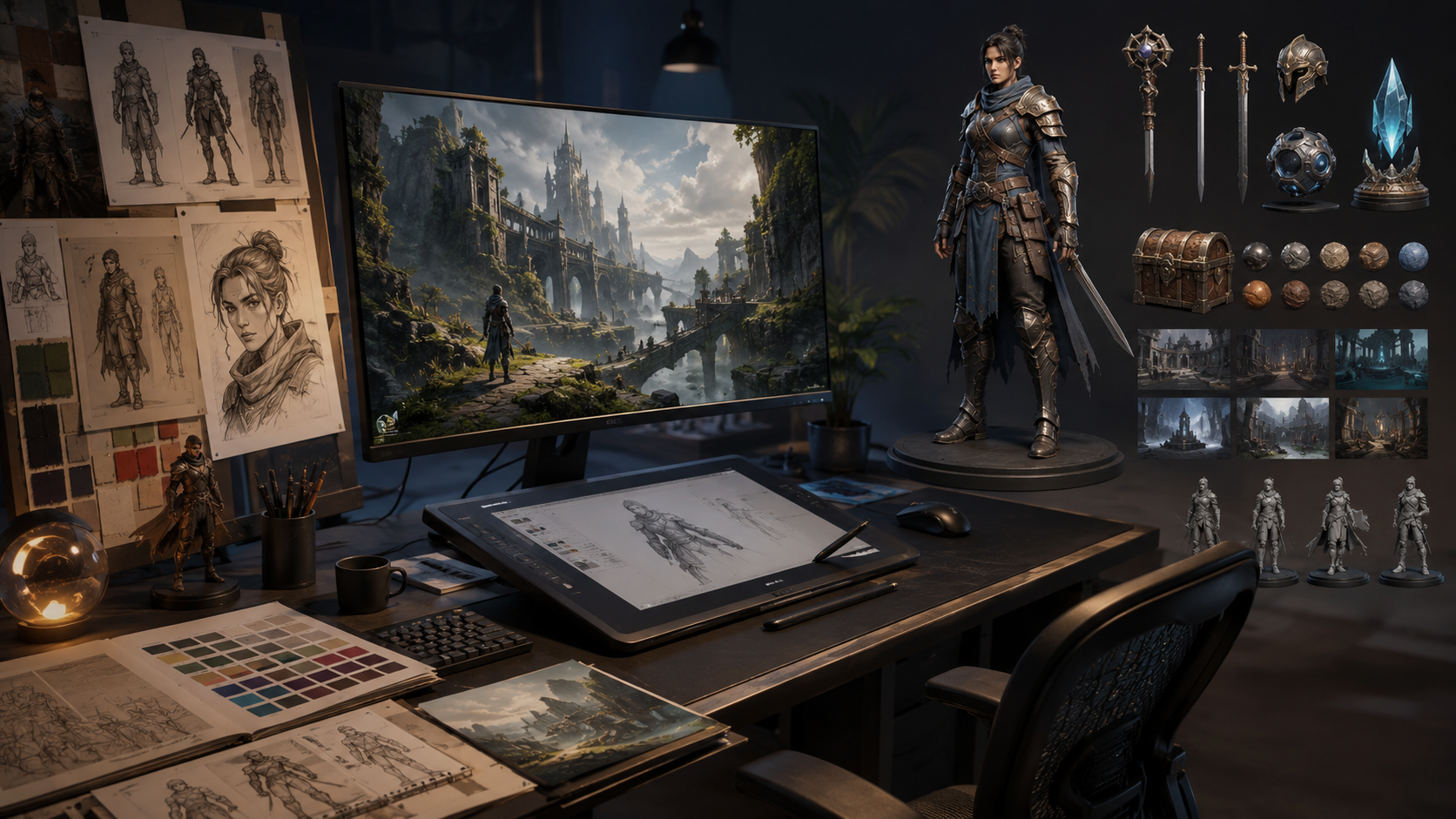

A game can have smart mechanics, clean code, and a clever monetization model. But players see the art first. They notice the character on the store page, the lighting in the opening scene, the animation of a sword swing, and even the tiny icon sitting in a menu.
That makes visual production a surprisingly big part of the development puzzle. And it explains why game art services have become relevant not only for large publishers but also for indie developers, mobile teams, VR projects, and studios building their first serious title.
The basic idea is simple. A studio needs artwork, but hiring a permanent specialist for every visual task doesn’t always make sense. One month the project needs ten environment artists. A few months later, the pressure moves to character animation or UI assets. External art teams can fill those gaps without forcing the developer to rebuild its internal staff every time the production schedule changes.
But there’s a catch. Good game art isn’t simply “pretty graphics.” An asset needs to fit the game’s style, engine, performance limits, camera distance, animation system, and actual gameplay. A beautiful character model that drops the frame rate isn’t finished. Neither is a gorgeous environment that looks like it belongs in a completely different game.
So, what exactly are studios looking for from game art services in 2026? Let’s break it down without turning this into an art-school lecture.
What falls under game art services?
The term covers a lot of ground. Sometimes a developer needs a few icons for a mobile title. Sometimes an external team is responsible for an entire city, dozens of characters, or hundreds of props.
Most game art services fall into several familiar areas:
- 2D art, concept art, illustrations, icons, backgrounds, and UI elements;
- 3D modeling, sculpting, retopology, UV work, texturing, and material creation;
- character design, creatures, clothing, weapons, props, and vehicles;
- environment art, architecture, vegetation, terrain, and set dressing;
- rigging, skinning, character animation, and gameplay animation;
- VFX, lighting, cinematic assets, promotional artwork, and art support for live games.
And yes, one studio can technically offer all of this. That doesn’t mean every provider is equally good at every category. A team known for realistic military vehicles may not be the obvious pick for a cozy hand-painted farming game.
This is where art direction matters. Technical skill gets an artist through the door. Matching the personality of the project is what makes the work actually belong there.
Game art isn’t just drawing anymore
Years ago, people outside development could imagine game artists simply sitting in front of Photoshop or a 3D program and creating nice pictures. The reality has always been messier, and today the technical side is impossible to ignore.
A modern 3D asset may pass through sculpting, retopology, UV mapping, texturing, rigging, engine import, material setup, LOD preparation, collision work, and optimization before a player ever sees it.
And every project has its own rules.
A rock made for a cinematic PC game isn’t necessarily built like a rock for a mobile strategy title. A character designed for close-up conversations needs different facial detail from a tiny NPC viewed from thirty feet away. Even two games built in the same engine may follow very different pipelines.
That’s why experienced game art services usually begin with technical requirements, not just reference pictures.
| Art task | What artists focus on | What developers need to define |
|---|---|---|
| Character art | Silhouette, anatomy, clothing, materials, facial detail | Poly budget, rig, camera distance, customization needs |
| Environment art | Architecture, terrain, props, mood, composition | Level size, performance target, modularity, engine setup |
| Animation | Movement, timing, weight, personality, readability | Skeleton, gameplay states, frame requirements, export rules |
| 2D art | Shape language, color, readability, visual identity | Resolution, aspect ratio, UI context, platform |
| VFX | Impact, timing, particles, motion, visual feedback | Performance limits, gameplay purpose, engine restrictions |
That may sound like production paperwork, but it saves a ridiculous amount of time later. Finding out that fifty finished assets don’t fit the project’s technical setup is the kind of surprise nobody wants on a Friday afternoon.
Why studios bring in external art teams
There isn’t one universal reason. Often it’s simply capacity.
Imagine a studio with six internal artists. Production suddenly reaches a point where the team needs forty buildings, hundreds of props, several NPCs, and new UI graphics within a few months. Hiring and onboarding another dozen people might take too long.
An outside team can add production capacity much faster.
Another common reason is specialization. A studio might have excellent environment artists but no creature specialist. Or its artists may work primarily in 3D while an upcoming feature needs polished 2D illustrations. Bringing in someone who already knows that craft can be far easier than building the skill internally under deadline pressure.
There are also less dramatic situations. Sometimes the core art team simply shouldn’t spend two weeks making fifty background objects. Their attention may be better spent defining the hero characters and locations while another team handles repeatable production work.
In practice, developers usually look outside the studio when they need:
- extra production capacity during a busy milestone;
- a visual specialty that isn’t available internally;
- support with large batches of similar assets;
- help finishing a backlog before launch;
- new content for an established live game;
- art production without expanding the permanent team too quickly.
None of this means the internal art department becomes less important. Quite the opposite. The strongest arrangements usually have clear internal ownership. Someone still needs to protect the visual language of the game and make the final calls.
The real challenge is visual consistency
Here’s a surprisingly common problem: every asset looks good on its own, but the game looks strange when everything comes together.
One character has soft, stylized proportions. Another looks realistic. A building has carefully worn surfaces while nearby props look factory-new. The trees belong in a painterly fantasy game, while the rocks look almost photoreal.
Nothing is technically terrible. Together, though? Something feels off.
This is why a clear art bible or visual guide matters so much when working with game art services. It doesn’t need to be a hundred-page document filled with corporate language. It needs to answer practical questions.
How exaggerated are shapes? How rough should metal appear? How much edge wear is acceptable? Are faces realistic or slightly stylized? How saturated is the world? How much detail should appear in the background?
Reference images help, but references alone can be vague. Five people can look at the same fantasy castle and notice five different things.
A small approved batch is often more useful than dozens of written instructions. Once everyone agrees that three or four sample assets feel right, those pieces become a visual target for the rest of production.
2D art is still doing a lot of heavy lifting
With so much attention on real-time 3D graphics, it’s easy to forget how much 2D artwork players encounter.
Mobile games rely heavily on icons, characters, event banners, backgrounds, cards, and interface elements. Strategy titles may need hundreds of portraits. RPGs need inventory icons and illustrations. Even realistic console games still need menus, concept art, marketing images, loading screens, and visual development.
Concept art also remains one of the cheapest places to make mistakes.
Changing a character’s armor in a concept sketch is fairly painless. Asking a team to rebuild the armor after modeling, texturing, rigging, and animation is another story entirely.
That’s why concept work shouldn’t be treated as decoration. It’s problem-solving with pictures.
3D production has become more flexible, not simpler
Real-time engines can display an impressive amount of detail, and production tools keep getting better. Unreal Engine and Unity support sophisticated rendering pipelines, while software such as Blender, Maya, ZBrush, and Substance 3D remains deeply tied to everyday asset production.
But better technology doesn’t magically remove technical decisions.
Artists still need to think about topology, materials, texture memory, skeletons, collisions, draw calls, lighting behavior, and the hardware expected to run the game.
In fact, more powerful tools can tempt teams into making assets heavier than necessary.
Think of it like packing for a road trip in a huge SUV. More trunk space doesn’t mean bringing your entire apartment is suddenly a great idea.
Game art services become particularly valuable here when the external artists understand both sides of production: how something should look and how it should behave once placed inside the engine.
Characters get attention, environments create the world
Main characters usually receive the glamorous part of the budget. Fair enough. Players may spend dozens of hours staring at them.
But environments quietly do enormous work.
A convincing level may need buildings, doors, windows, street furniture, rocks, plants, signs, trash, cables, fences, furniture, decals, background objects, and dozens of tiny details nobody consciously notices.
Remove those details and suddenly the world feels like a movie set five minutes before construction finished.
Environment production is also where outsourcing can make practical sense because many projects need large quantities of assets built around consistent specifications.
Modular kits are a good example. Instead of making every building from scratch, artists create reusable walls, corners, windows, floors, roofs, and decorative pieces. Level designers can then combine those parts in different ways.
Done well, players see variety. The production team sees a system.
Animation is where static art finally has to behave
A character can look fantastic in a portfolio image and still feel awful in motion.
Animation affects more than appearance. It communicates gameplay.
Players need to read attacks, reactions, jumps, dodges, reloads, spells, and interactions quickly. A stylish animation that hides important timing can create real gameplay problems.
Good animators think about weight, anticipation, rhythm, silhouette, and personality, but they also think about state machines, transitions, skeleton restrictions, root motion, loops, and engine implementation.
This is one reason studios should be careful when evaluating game art services purely from beautiful showreels. A cinematic animation and a responsive gameplay animation aren’t the same job.
And then AI entered the art conversation
You can barely discuss digital art in 2026 without AI showing up somewhere in the conversation.
AI-assisted features now appear around concept exploration, textures, materials, animation-related workflows, and other areas of digital production. That doesn’t mean game studios can type one sentence into a box and receive a production-ready world.
There is still a large gap between something that looks convincing in a preview and something that behaves correctly inside an actual game.
A production asset may need predictable topology, UVs, editable materials, specific dimensions, clean rigging, consistent naming, animation compatibility, collision data, and predictable performance.
And style matters just as much. Generating ten individually attractive images is easy compared with keeping hundreds of assets inside one deliberate visual language.
So the interesting question isn’t really, “Will AI replace game artists?” A more useful question is, “Which repetitive steps can become faster while artists keep control of the result?”
That’s far closer to what production teams actually care about.
What a healthy game art workflow looks like
A good external art pipeline tends to feel almost boring. That’s a compliment.
The brief arrives. Questions get answered. A small test or first batch is produced. Feedback comes back. Standards become clearer. Production picks up speed.
Problems usually appear when teams skip the boring part and rush directly toward quantity.
The safest process normally includes:
- a clear visual brief with references and approved examples;
- technical specifications for the engine and target hardware;
- a small test asset or pilot batch before mass production;
- named people responsible for feedback and approval;
- regular reviews instead of one giant review at the finish line;
- clear file structure, naming rules, source files, and delivery standards.
That last point sounds painfully ordinary until somebody opens a project folder containing files named final_character.psd, final_character2.psd, final_character_NEW.psd, and final_character_REALFINAL.psd.
We’ve all seen some version of that chaos.
How to evaluate game art services without guessing
A flashy portfolio is useful, but it shouldn’t be the entire decision.
First, look for work that resembles the production problem you actually have. If you’re making a stylized mobile game, a gorgeous portfolio filled entirely with realistic automotive models tells you something about craftsmanship, but not everything you need to know.
Then look for consistency. One amazing image is easier to produce than fifty assets that clearly belong to the same universe.
Technical understanding matters too. Ask how assets are prepared for the engine, how revisions are handled, and what information the artists need before starting.
| What to check | Good sign | Possible warning sign |
|---|---|---|
| Portfolio | Several relevant examples with consistent quality | One strong hero piece surrounded by unrelated work |
| Technical knowledge | Artists ask about engine, platform, budgets, and pipeline | Conversation stays focused only on visual references |
| Feedback process | Review stages and approval points are clear | Revisions are discussed vaguely |
| Communication | Questions appear early and decisions are documented | Problems stay hidden until delivery |
| Test production | A representative asset can be tested first | Large-volume production starts before standards are proven |
| Source files | Delivery format and ownership expectations are defined | Nobody has discussed what will actually be handed over |
One more thing: pay attention to the questions you’re being asked.
An experienced artist doesn’t just say, “Sure, send the references.” They want to know where the asset appears, how close the camera gets, whether it moves, what platform matters, what the material system looks like, and who approves the work.
Good questions are usually a good sign.
Should indie developers consider game art services?
Absolutely, but not automatically.
A tiny studio doesn’t need an external production team simply because larger studios have one. Sometimes the smartest approach is keeping the art small and building around the strengths of the people already involved.
Still, there are moments when outside help makes sense.
Maybe your programmer-built prototype suddenly needs proper visual direction before a publisher pitch. Maybe you’re happy creating environments but hate rigging characters. Maybe the game is nearly finished and you need a polished key image for the store page.
In those cases, commissioning a specific part of production can be far more practical than trying to become an expert in every discipline yourself.
Indie developers should also remember that scope is an art decision.
A smaller visual idea executed consistently will usually look better than an ambitious idea that runs out of time halfway through.
How much should visual style depend on trends?
Trends can help a game feel current. They can also make it look strangely familiar.
Players have seen a lot of realistic military gear, neon cyberpunk alleys, cozy farms, low-poly landscapes, anime-inspired characters, hand-painted fantasy worlds, and chunky retro pixels. None of those styles is suddenly bad. The problem starts when the project has no visual thought beyond “people seem to like this.”
Strong art direction has a reason behind it.
Maybe the shapes are simple because the camera stays far from the characters. Maybe the colors are warm because the game should feel safe. Maybe environments avoid visual clutter because players need to spot interactive objects instantly.
Style isn’t frosting placed on top of gameplay. At its best, it helps the player understand the game.
What can go wrong with external art production?
Plenty. Usually for very ordinary reasons.
The brief changes. Feedback arrives from five people who disagree with one another. Technical requirements appear halfway through production. A concept gets approved even though nobody from the gameplay team has checked whether it works.
Then revisions pile up.
Another issue is outsourcing too early. If the studio hasn’t decided what its own game looks like, an external team can’t magically make that decision disappear.
Artists can explore directions, of course. But somebody still has to say, “Yes, this is our game.”
And outsourcing too late creates the opposite problem. If a deadline is already on fire, adding more people doesn’t instantly fix everything. New artists need references, files, feedback, access, and time to understand the project.
More hands can increase speed only when the production setup is ready for more hands.
The small details that separate usable art from finished art
Players may never know whether a texture was packed correctly or a skeleton followed a naming convention. Developers certainly will.
Professional game art services aren’t judged only by screenshots. They’re judged by what happens after those files enter production.
Can the level designer place the asset without fixing it? Does the material behave correctly? Do animations retarget as expected? Are pivots where they need to be? Are textures delivered at sensible sizes? Can another artist open the source file six months later and understand it?
These aren’t glamorous questions, but they often determine whether outside production actually saves time.
FAQ about game art services
What are game art services?
Game art services are professional art-production services created for video games. They may cover concept art, 2D graphics, 3D modeling, characters, environments, animation, VFX, UI assets, textures, and related production work.
Do game art services work only with large studios?
No. Indie developers, mobile teams, startups, publishers, and established studios can all hire external artists. The scope might range from one character or key illustration to months of ongoing asset production.
Can an external art team work directly with Unity or Unreal Engine?
Yes, depending on the team’s technical experience and the agreed pipeline. Studios should define engine requirements, import settings, materials, naming rules, performance targets, and delivery formats before major production starts.
Is concept art necessary before 3D modeling?
Not every object needs a detailed concept sheet, but important characters, locations, weapons, and unfamiliar designs usually benefit from visual planning. Changing an idea during concept work is generally easier than rebuilding a finished 3D asset.
Can AI generate finished game assets now?
AI-assisted tools can help with parts of ideation and production, but a visually convincing result isn’t automatically a game-ready asset. Technical requirements, editing, consistency, performance, rigging, topology, and art direction still matter.
How can a studio keep outsourced artwork consistent?
Start with a strong visual guide, clear references, approved examples, and one reliable feedback process. Testing a small batch before producing dozens of assets also helps catch style differences early.
What should developers ask before hiring game art services?
Ask about relevant portfolio work, technical pipeline, revision stages, communication, delivery formats, source files, engine experience, ownership terms, and how the team handles quality control across larger batches.
Conclusion: great game art is a production system
It’s tempting to think of game art as a collection of images, models, and animations. In a finished game, though, everything is connected.
The character has to fit the environment. The animation has to fit the mechanics. The materials have to fit the lighting. The detail level has to fit the hardware. And hundreds or even thousands of individual decisions need to feel like they came from the same creative idea.
That’s the real value of good game art services. They don’t simply provide more people who can draw or model. They add production capacity while working inside the visual and technical rules of the project.
And in 2026, that balance matters. Art tools are faster, real-time graphics keep improving, and AI-assisted workflows are changing parts of production. Yet the basic challenge hasn’t disappeared: somebody still needs to decide what the game should look like, why it should look that way, and how every asset supports that idea.
Technology can make the brush faster. It doesn’t decide what deserves to be painted.
Leave a Reply