

Double jump silksong: how Hornet’s backflip changes traversal
Team Cherry’s Silksong hands Hornet a backflip from the first room, and that single decision has reshaped almost every preview conversation about how the sequel will play. Hollow Knight gave the Knight a second jump through the Monarch Wings, a late-game ability that arrived with a cutscene and a tooltip. Silksong folds a similar aerial verb into Hornet’s baseline movement and frames it as a controlled pivot rather than a symmetrical second hop. The result is a faster opening hour, narrower platforms across Pharloom, and a fresh set of questions for anyone studying how a flagship indie metroidvania paces aerial movement.
What follows draws on public previews, the official update notes Team Cherry has published so far, and the long-running design conversation around the double jump as a platforming primitive. It is written for two groups: players who want a clear sense of what the move does on day one, and developers who want to see how a default aerial verb changes room sizing, boss design, and the early-game difficulty curve. There is no speculation about an unannounced release window, no promotion of a specific studio service, and no invented mechanics. The focus is the evidence that already exists in footage and in the wider metroidvania record.
What the double jump in Silksong actually does
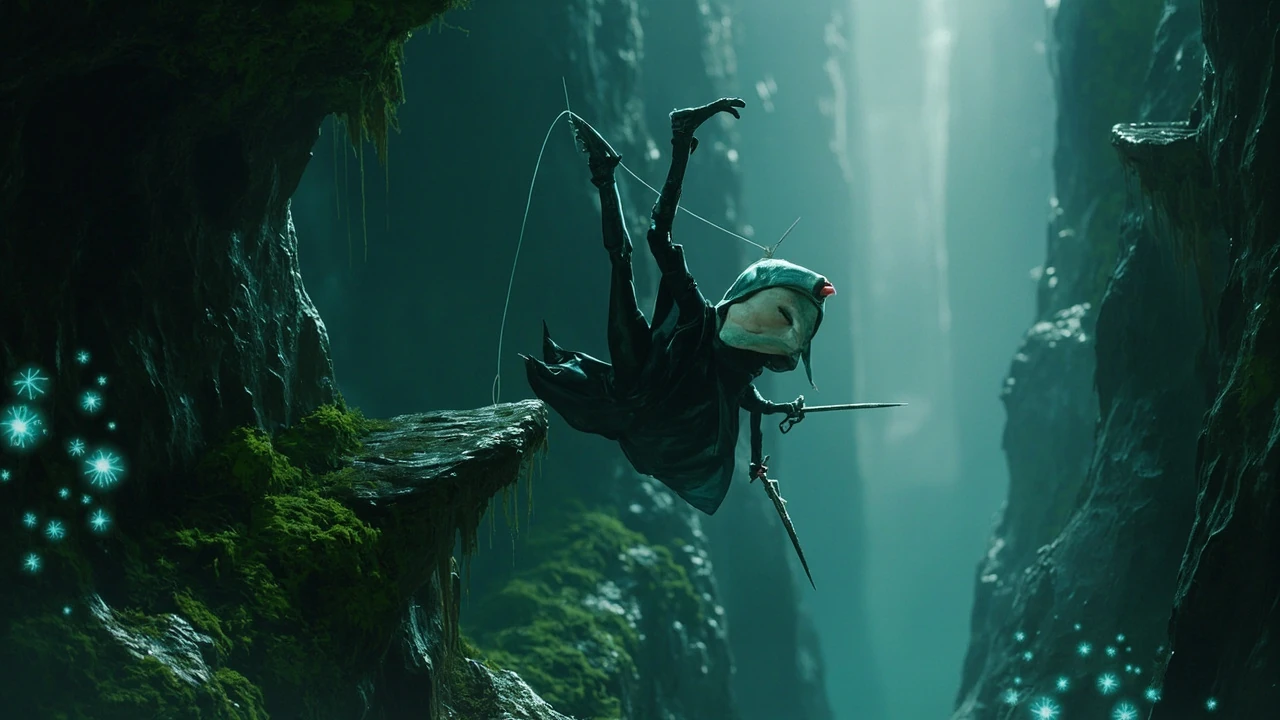
Hornet’s backflip starts from a normal jump, consumes no resource in the previews, and lets the character spin once in mid-air to either gain a small amount of extra height or redirect toward a wall, platform, or enemy. The animation is closer to a controlled aerial pivot than to the symmetrical second hop that platformers have used for decades. The spin itself adds a small amount of vertical lift, which is why preview footage shows players pressing the input slightly after the visible peak of the first jump rather than on it.
The brief hover at the top of the spin also gives Hornet a short window in which she can aim her needle downward or sideways. That hover is what makes the move an offensive tool as well as a traversal one. In preview clips the backflip shows up as an anti-air counter against flying enemies and as a recovery from a downward strike, which keeps the pace of fights and the pace of exploration tied to the same input.
The table below summarises the visible behaviour of the move across the preview set.
| Property | Observed in Silksong previews |
|---|---|
| Availability | From the first room, no unlock gate |
| Resource cost | No visible silk or gauge cost in current footage |
| Input window | Slightly after the visible peak of the first jump |
| Vertical lift | Small, roughly one Hornet-height above the first jump’s apex |
| Horizontal reach | Enough to extend a sprint-plus-jump across a wide gap |
| Combat use | Anti-air pivot, recovery from a downward strike, redirect out of a horizontal sweep |
| Chaining | No preview shows a second backflip in the same air time |
That list is descriptive, not promotional. It is the set of behaviours that the hands-on coverage and the official update notes agree on, and it is the set the rest of this article refers back to.
How the move has been demonstrated in public previews
Hands-on previews from outlets that received early code have produced the most reliable descriptions of the backflip. Three observations come up consistently. The move is available from the start, it costs nothing in the previews, and it can be combined with Hornet’s other movement verbs without a cooldown gate. Several previews also mention that the spin can be used to break the momentum of a long fall, which lets a player correct an over-commit on a long descent without taking a fatal hit.
The footage that has circulated shows three recurring uses:
- Crossing a wide gap by chaining a sprint, a single jump, and a backflip at the apex to land on a narrow platform.
- Redirecting mid-air to avoid an enemy projectile that arrives partway through the first jump’s arc.
- Extending an upward climb by bouncing off a small enemy or a fragile platform, with the backflip adding a second lift.
Those patterns are common in the wider platformer genre. The part that is specific to Silksong is the timing. Watching the clips closely shows the input happens slightly after the highest visible point of the first jump, which is the window the developers appear to have tuned for. Players who learned Hollow Knight’s Monarch Wings timing will have to unlearn the reflex of pressing immediately on the peak.
Why a backflip is part of Hornet’s default kit
Hornet walks and drifts through the air faster than the Knight did. If she were locked to a single jump, that faster drift would push her past platforms more often, and the level designers would have to widen every platform to compensate. A default backflip keeps platforms narrow without forcing the team to slow her down, which is the trade the developers appear to have made.
That trade also lets the art team be more aggressive with vertical sections. Hollow Knight’s tall shafts often relied on the Crystal Heart, a long horizontal dash, to turn a narrow column of platforms into something a player could cross. Silksong’s vertical sections can use a single jump plus a backflip instead, which leaves room for tighter corridors and a more varied use of height. From a level-design perspective, the backflip is the price the team pays for giving Hornet more horizontal speed without paying the cost of wider floors.
There is a character reason too. Hornet’s combat in the predecessor was built around her needle and her thread, both of which are associated with mid-air pivots and aerial redirection. A backflip that lets her redirect mid-air is consistent with how she was animated in the original game, and a symmetrical second jump would not match the silhouette that long-time players already associate with the character.
How the Silksong double jump compares with Hollow Knight’s progression
Hollow Knight’s aerial growth was distributed across several abilities, each of which opened new terrain and combat options. The table below lines up the most relevant pieces of that progression with what the public previews of Silksong have shown so far.
| Ability | Hollow Knight | Silksong (as shown in previews) |
|---|---|---|
| Single jump | Available from the start, with a fixed arc | Available from the start, slightly higher and faster arc |
| Second jump in the air | Granted by the Monarch Wings, late game | Default backflip, available from the start |
| Long horizontal dash | Crystal Heart, mid game | Replaced by a sprint plus backflip, available from the start |
| Wall jump | Available from the start with the Mantis Claw | Available from the start, with a slightly larger wall-leap window |
| Downward strike | Granted by the Desolate Dive spell | Built into the backflip’s aerial recovery |
The second row is the one that changes the feel of the early game. Hollow Knight treated the second jump as a reward for reaching a specific region and defeating a specific boss. Silksong gives the backflip to the player immediately and uses late-game abilities to add functions on top of it, rather than as a prerequisite for basic navigation. That single decision is what makes the first hour of the sequel feel faster.
How developers can use a built-in double jump to shape level pacing
For developers, the more useful question is how to pace a metroidvania around a default aerial verb, and Silksong’s preview rooms are a working reference. A few principles are visible in the way the early-game chambers have been laid out.
- Use the backflip to set the maximum room width. A designer who knows every player has access to a backflip can size platforms around the maximum jump-plus-flip distance instead of around a default jump alone.
- Let the backflip set a minimum ceiling height. A short backflip will not fit in a low corridor, which is a quiet way to block the player from a route they are not ready for without using a hard gate.
- Combine the backflip with environmental cues. Mossy ledges, hanging silk, and small flying enemies all show up near the platforms that require a flip, and each cue gives the player a different reason to try the move.
- Use the backflip’s combat recovery as a difficulty lever. The same move that helps in exploration is the move that saves the player from an anti-air hit, and that overlap is what keeps the combat and exploration systems linked.
- Keep late-game abilities additive. A glide, a dash, and a charged jump can be combined into a single late-game path, but the backflip itself should not be the gate that prevents the player from progressing.
None of those principles are unique to Silksong. They are visible in the way the sequel’s rooms have been previewed, and they line up with the broader design record on the double jump as a platforming primitive that has been used in side-scrollers since the 1980s. A concise summary of that record is available on the Wikipedia page covering the double jump in video games, which traces the move from early arcade platformers through its use as a progression-gated ability and into its modern role as a baseline movement verb.
What the move changes for combat
Hornet’s combat in the original game was built around her needle, her thread, and her tendency to redirect in mid-air. The backflip extends that pattern. The most visible change is in anti-air combat: a player who can flip after a jump can turn an incoming flying enemy into a downward strike without committing to a long recovery animation. On paper the change is small, but it is one of the reasons preview combat has felt faster.
The same move also affects boss design. A boss that launches a horizontal swipe no longer punishes the player for being mid-air, because the backflip is fast enough to redirect the player out of the swing. Several preview clips show players using the backflip as a defensive tool, jumping into a hit that looks unavoidable and then spinning out of the recovery. That kind of “I meant to do that” recovery depends on a tight input window. A backflip with too long an animation would lose the defensive use; one that is too short would lose the visual readability.
There is a cost. Because the backflip is a recovery tool, the developers have to be careful that bosses do not require long aerial combos the backflip would interrupt. The current preview set suggests that bosses tend to create short windows, often around half a second, in which the player can land a hit and either fall or flip out, rather than the longer aerial juggling that some action games allow. That keeps the backflip useful without making it dominant.
Common pitfalls players run into when learning the move
Players coming from Hollow Knight tend to make a small set of predictable mistakes when they first try Hornet’s backflip. The list below captures the most common ones, with the underlying reason and a quick way to retrain the muscle memory.
- Pressing the jump button at the peak. The backflip has a later input window than a symmetrical second jump, and pressing on the apex can clip the platform you were aiming for.
- Trying to redirect downward. The backflip adds lift, so flipping as a fast-fall tends to leave the player hanging in the air longer than expected. A cleaner fall is to stop holding the direction, let gravity pull Hornet down, and only flip if the platform is still within reach.
- Mixing up the backflip with the dash. The dash is a separate verb, and pressing the backflip during a dash interrupts the dash. The two moves are best used in sequence, not in parallel.
- Forgetting the backflip on long falls. The spin can break a long fall’s momentum, but only if the player commits to it near the bottom. Players who flip too high end up resetting the fall and losing the recovery.
- Trying to use the backflip as an attack on its own. The move is a recovery and a redirect, not a damage-dealing strike. Using it on a grounded enemy often leaves Hornet in a vulnerable state.
None of these are hard failures. They are timing mismatches that fade after a few rooms, but they are the difference between an early game that feels rough and one that feels smooth.
How the backflip interacts with other movement options
Hornet’s traversal kit is a small set of verbs that combine in specific ways. The interaction between the backflip and the other moves is the part the previews describe in the most detail, and it is the part experienced players will spend the most time on.
| Combination | What it does in practice | Where it shows up in the preview |
|---|---|---|
| Sprint + jump + backflip | Covers a long horizontal gap, more than a single jump could reach | Wide chambers with a single small platform in the middle |
| Wall jump + backflip | Redirects away from the wall, useful for narrow vertical shafts | Climbing sequences in mossy corridors |
| Down strike + backflip | Recovers from a downward attack into a safe aerial pivot | Fights against flying enemies in open rooms |
| Dash + backflip | Extends a horizontal dash into a slight upward lift | Long corridors with a low ceiling |
| Backflip + silk | Uses a silk thread to swing out of the backflip’s hover | Vertical sections with hanging rings |
These combinations show up in plenty of other platformers. The part that belongs to Silksong is the way the backflip acts as a hinge between them. The same input that opens a vertical route also opens an offensive recovery, and that overlap is what gives Hornet the impression of a single coherent movement set rather than a list of unrelated moves.
What we still do not know about the move
Several details about the double jump in Silksong remain unconfirmed. The most important open questions are listed below, with the reason each one matters for players and developers.
- Whether the move is upgraded by a late-game ability. Several abilities in the predecessor turned single jumps into longer arcs; a similar ability for the backflip would change the late-game exploration.
- Whether the backflip consumes silk. The current preview set shows the move being used without a visible resource cost, but a final balance pass could change that.
- Whether the backflip can be chained. Chaining two backflips would create a very long air time, and the developers may have placed an internal cooldown to prevent that.
- Whether the move changes the input binding. A backflip that is mapped to the jump button rather than a separate button is friendlier for new players, but it can also produce accidental flips during normal jumps.
- Whether the move is available in all forms. Some metroidvanias gate parts of the kit behind transformations; the current previews show Hornet in her standard form, so the move’s behaviour in any alternate form is unconfirmed.
These open questions are not gaps to be filled with speculation. They are the items to watch for in the official patch notes when the game ships, and they are the items that will determine how the backflip feels a hundred hours in.
How the move shapes the early-game difficulty curve
One of the more interesting consequences of giving Hornet a default backflip is that the early-game difficulty curve changes. In Hollow Knight, the early rooms had to be tuned for a single jump, which made the opening hours feel grounded. In Silksong, the early rooms can be tuned for a player who can already flip, which lets the developers make the opening vertical sections tighter and faster without making them unfair.
The trade-off is that the early game has fewer “first unlock” moments. Hollow Knight’s Monarch Wings and Crystal Heart were both treated as significant ability unlocks, with the game pausing for a brief cutscene and a tooltip. Silksong’s open question is what replaces those moments. The current preview set suggests a larger number of smaller unlocks, each of which adds a small function to the existing kit rather than introducing a new verb. That pattern fits a movement system in which the basic verbs are present from the start and the late-game abilities are modifiers.
For developers, the lesson is that a built-in double jump does not remove the sense of progression. The player still feels growth, but the growth is in how the moves combine rather than in which moves are available. That is a different design problem, and it requires the level design to keep introducing fresh combinations instead of fresh verbs.
How the backflip affects boss design in practice
Boss design in a metroidvania is a useful stress test for any default movement ability, and the public previews of Silksong show three patterns worth recording. The first is that bosses tend to create short aerial windows of about half a second, in which a player can either land a hit or use the backflip to reset. The second is that bosses frequently use a horizontal sweep that the backflip is designed to escape. The third is that bosses occasionally have a phase in which the player is expected to climb a vertical surface while the boss attacks from the side, and the backflip is what lets the player redirect away from the wall.
Each of those patterns gives the backflip a clear role. A boss that did not create an aerial window would make the backflip feel irrelevant. A boss that did not have a horizontal sweep would not test the backflip’s defensive use. A boss that did not have a vertical surface to climb would not test the wall-jump combination. The trio of patterns is a reminder that a movement ability only feels meaningful if the encounters actually use it.
For developers, the practical implication is that the boss moves have to be designed alongside the backflip rather than after it. A boss designed for a single-jump protagonist and then layered with a backflip will end up either too easy or too punishing, depending on which attack the backflip interrupts. The preview set suggests that Silksong’s boss moves were tuned with the backflip in mind from the start.
How the move fits into the wider metroidvania conversation
The double jump has been a staple of platforming since the 1980s, and its use in metroidvanias has evolved over the same period. Hollow Knight’s late-game second jump was an explicit callback to the way the genre treated the move as a reward. Silksong’s default backflip is part of a wider trend, visible in several recent metroidvanias, in which the basic aerial verb is part of the protagonist’s default kit and the late-game abilities are modifiers. That shift has been accelerated by higher default movement speed and a wider tolerance for a steeper early-game difficulty curve.
The shift has its critics. Some players prefer the slower pacing of a metroidvania in which the second jump is a reward, and they find a default backflip too forgiving. The developers’ answer, judging from the preview set, is to compensate with tighter room design and more aggressive enemy placement, so the player has the move but the move does not trivialize the level. That balance is one of the more interesting design questions that Silksong will be cited for in future discussions of the genre.
What players should practice before launch
Players who want to be ready for the move on day one can run a short, repeatable set of drills on the original game or on any platformer that supports a backflip. The list below is a short, focused set of exercises that target the timing window the move uses.
- Jump, then press the backflip slightly after the visible peak, and aim for a target about one Hornet-height above the first jump’s apex.
- Sprint, jump, and backflip across a flat corridor, with the goal of landing on a single small platform without overshooting.
- Wall jump off a vertical surface and immediately backflip away from the wall, aiming for a platform on the opposite side.
- Down strike an enemy and backflip out of the recovery, landing on a platform that is lower than the enemy’s position.
- Hold the backflip at the top of a long fall and try to land on a narrow platform without taking damage from the fall itself.
These drills do not require the final game. They can be done in any platformer that exposes a similar backflip, and they target the timing window the previews have shown. Players who run them for a few minutes will be noticeably smoother on the first day of play.
What developers can learn from the move’s design
For developers, the backflip is a small case study in how a single input can change the feel of a metroidvania. The same move has been part of platforming for decades, but the way Silksong uses it as a default verb is a reminder that the placement of an ability in the progression tree is as important as the ability itself.
- A default movement verb is not a free difficulty reduction. It is a redistribution of difficulty, and the level design has to absorb the change.
- A backflip is more than a second jump. The way it is animated, timed, and combined with other moves is what gives it a unique identity.
- Late-game abilities are more interesting when they are modifiers rather than prerequisites. A built-in basic verb leaves room for late-game abilities to be about flavour and combination.
- Boss design has to be tuned to the default kit. A movement ability introduced after the bosses are designed will not feel coherent in combat.
- The design of any movement ability is the design of the level art and the boss moves that surround it.
None of those lessons are unique to Silksong, but the game is a clear example of how a small, default ability can shape an entire design.
How the move will likely be discussed after launch
After the game is in players’ hands, the move will probably be discussed along three axes. The first is the question of whether the default backflip changes the early-game difficulty curve in a way the developers intended. The second is whether the late-game modifiers on the backflip make the move feel like it grows with the player, or whether the modifiers feel tacked on. The third is whether the move interacts with the boss moves in a way the preview set does not fully expose.
None of these questions can be answered from previews alone. They are the questions that players will have to answer with their own hands on the controller. The goal of this article is to lay out the evidence that already exists, so the post-launch conversation can focus on the design questions rather than on the basics of how the move works.
Frequently asked questions
Does Hornet have a double jump in Silksong?
Yes. Public previews show Hornet performing a backflip while already in the air, available from the start of the game without an unlock. The move is presented as a default part of her movement kit rather than as a late-game ability.
Is the Silksong double jump the same as Hollow Knight’s Monarch Wings?
No. Hollow Knight’s Monarch Wings were a late-game ability that gave the Knight a symmetrical second jump. Silksong’s backflip is available from the start, costs no resource, and is animated as a controlled pivot rather than a symmetrical second hop. The two moves are similar in result but different in design intent and in how the player is expected to time the input.
When do you get the double jump in Silksong?
The previews indicate the backflip is part of Hornet’s default kit and is available from the first room. There is no unlock gate in the public footage, although specific modifiers or upgrades tied to the move may appear later in the game.
Does the backflip cost silk?
The previews show the move being used without a visible silk cost. A final balance pass could change that, but the current evidence is that the move is free to use.
Can the backflip be chained into a third jump?
The previews do not show the backflip being chained into a second backflip. Most aerial sequences in the preview set end with a fall or a wall jump rather than a second backflip, which suggests an internal cooldown or a designed limit on consecutive flips.
Is the backflip useful in combat?
Yes. The brief hover at the top of the spin gives Hornet a short window in which she can aim a downward strike or redirect away from an enemy. The move is most useful against flying enemies and against bosses with horizontal sweeps that the player can flip out of.
How do you time the backflip input?
The previews show the input being pressed slightly after the visible peak of the first jump, not exactly on it. Pressing on the apex tends to clip platforms that the move is designed to reach.
Does the backflip work with the dash?
Yes. A dash followed by a backflip gives a small upward lift at the end of the dash, which is useful for clearing a long corridor with a low ceiling. Pressing the backflip during a dash interrupts the dash, so the two moves are best used in sequence.
Does the backflip work with the wall jump?
Yes. A wall jump followed by a backflip lets the player redirect away from the wall, which is useful in narrow vertical shafts. The combination is one of the more consistent ways the move shows up in the preview footage.
Will the backflip change on higher difficulty settings?
There is no public information on difficulty settings. The previews have used a single default mode, and any changes to the move’s timing or reach on a higher difficulty would need to be confirmed in official patch notes.
Leave a Reply