

Having an idea for a game is the fun part. You picture the characters, the world, maybe a clever mechanic that feels obvious once you explain it. Then someone asks a very normal question: “Okay, but how do we build it?”
That’s where things get real.
A game development company turns an idea into something people can actually install, play, break, restart, update, and hopefully recommend to their friends. That can mean building a tiny mobile puzzle game or coordinating years of work on a large PC or console title.
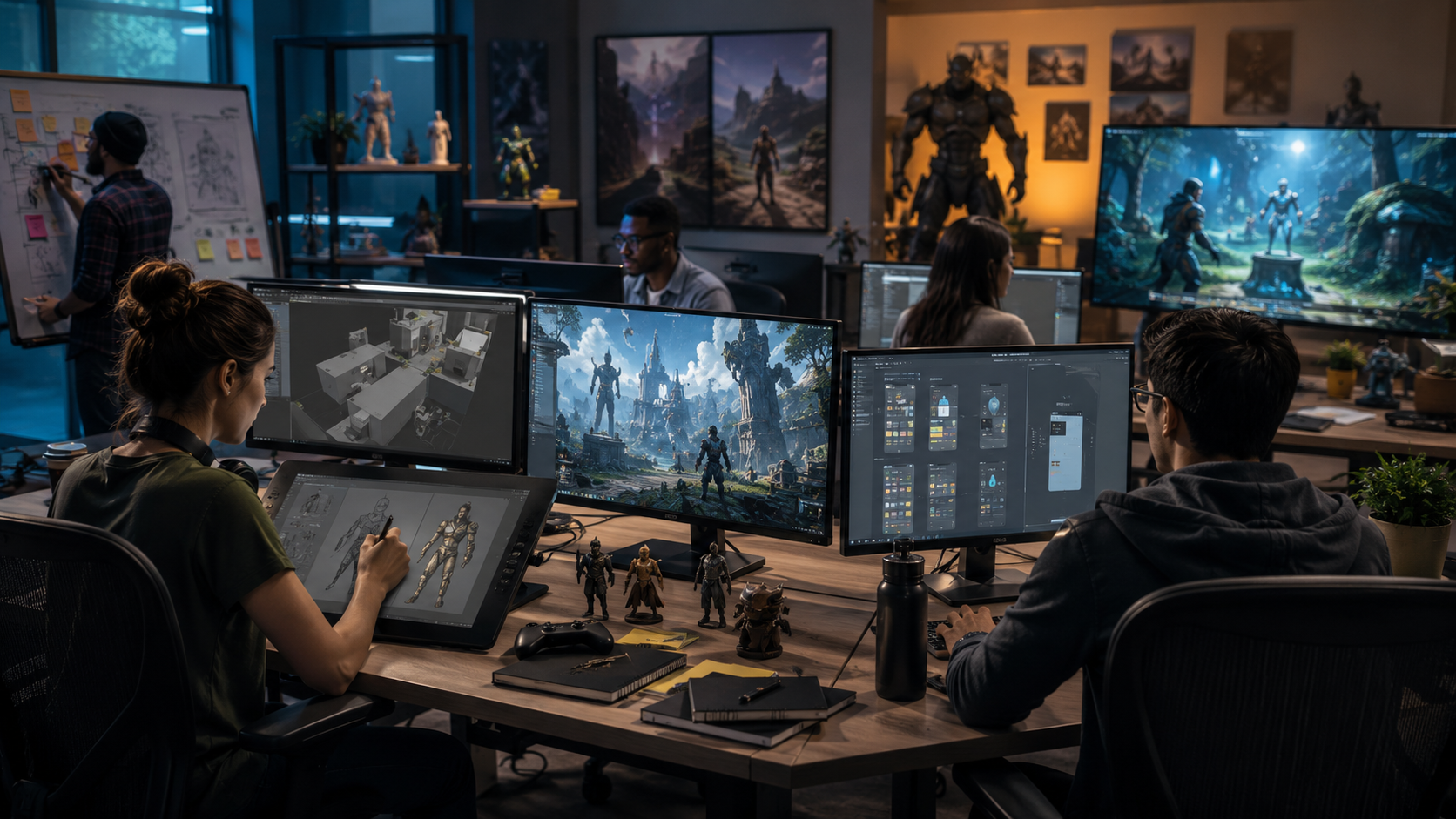
The job goes far beyond writing code. A typical project can involve game designers, developers, 2D and 3D artists, animators, UI designers, technical artists, sound specialists, producers, QA testers, and other people whose work overlaps constantly.
And that’s one reason game production can feel confusing from the outside. You aren’t ordering a product that already exists. You’re paying a team to solve hundreds of small problems while gradually figuring out what the final product should become.
So if you’re thinking about working with a game development company in 2026, it helps to understand what happens behind the scenes before talking about prices, deadlines, or shiny graphics.
A game starts with much less game than you’d expect
Most good projects don’t begin with twenty characters and a giant map. They begin with questions.
Who is the game for? What does the player do again and again? Is it supposed to be relaxing, competitive, funny, tense, social, or something else? Will people play for five minutes on a phone or spend entire evenings exploring on PC?
Those questions sound basic. They’re not.
Imagine somebody says, “I want a multiplayer survival game with crafting.” That’s an idea, but it’s nowhere near a production plan. How many players share a session? Can they build structures? Is there PvP? How large is the world? Do characters keep their inventory between sessions? What happens when someone disconnects?
Each answer creates more work somewhere else.
That’s why a serious game development company often spends time on discovery and pre-production before full production begins. It isn’t wasted time. It’s the part where expensive mistakes are still cheap.
What can a game development company handle?
The exact services depend on the studio. Some teams specialize in one area. Others can take a project from early planning through release and post-launch support.
A broader team may cover:
- game concept development, mechanics, systems, and documentation;
- prototyping and proof-of-concept development;
- 2D art, 3D modeling, animation, UI, VFX, and technical art;
- front-end and back-end programming;
- multiplayer systems, accounts, saves, inventories, and online features;
- sound integration, music implementation, and voice-over support;
- quality assurance, performance testing, and bug fixing;
- store preparation, release builds, updates, and post-launch support.
Does every game need all of those things? Nope.
A simple offline puzzle title may have no servers at all. A competitive online game can depend heavily on backend architecture. A narrative title may spend a huge part of its production budget on characters, dialogue, cinematics, and animation.
The right production setup comes from the game itself, not from a generic checklist.
Prototype first, beautiful screenshots later
One of the smartest things a team can build early is something that looks a little ugly.
Seriously.
A prototype exists to answer questions about gameplay, not impress people on social media. Characters might be capsules. Buildings could be gray boxes. Buttons may look painfully basic.
But if the main mechanic is fun in that state, you’ve learned something valuable.
Consider a game built around controlling gravity. Spending months creating gorgeous environments before confirming that the gravity mechanic feels good would be risky. A quick prototype can tell the team whether the idea works while changing direction is still relatively painless.
There’s a useful phrase in development: find the fun. It sounds casual, but there’s a serious production idea behind it.
Graphics can polish an experience. They have a much harder time rescuing a core loop nobody enjoys.
From prototype to production: where the project gets bigger
Once the basic direction works, production begins to expand.
The placeholder character needs an actual model. Menus need designs. Levels need art. Animations need transitions. Audio needs events. Save systems need error handling. Somebody discovers that players can jump onto a roof they were never supposed to reach.
And suddenly that charming prototype has become a real software project.
| Stage | Main goal | Typical work |
|---|---|---|
| Discovery | Define the idea and scope | Research, requirements, audience, platform decisions |
| Pre-production | Test the direction | Prototype, art tests, technical planning, game design |
| Production | Build the actual game | Programming, art, animation, levels, UI, audio |
| Alpha | Get major systems working together | Feature testing, integration, bug fixing |
| Beta | Prepare for release quality | Polish, optimization, balancing, wider testing |
| Launch | Ship a stable build | Platform checks, release preparation, urgent fixes |
| Post-launch | Keep the game healthy | Patches, content, support, live operations |
The names of these stages aren’t universal. Different studios organize production differently. The useful part is the general pattern: ideas become tests, tests become systems, and systems gradually become a product.
Which game engine makes sense in 2026?
This question comes up almost immediately, and people sometimes give it more drama than it deserves.
Unreal Engine, Unity, and Godot are among the engines developers may consider, while some studios maintain proprietary technology for particular projects. There isn’t one engine that’s automatically right for every game.
Unreal Engine is strongly associated with high-end 3D production and includes tools for areas such as dynamic lighting, detailed geometry, world building, animation, and visual scripting.
Unity continues to serve projects across 2D and 3D development and a broad range of platforms. Its ecosystem also makes it familiar territory for many professional developers.
Godot is an open-source option with dedicated 2D and 3D workflows and has become a serious part of conversations around independent game production.
But here’s the thing: engine selection shouldn’t happen because somebody watched an impressive tech demo.
The team should consider the game, target platforms, performance requirements, online features, existing expertise, production tools, licensing, and long-term maintenance.
If a company already has five experienced developers working efficiently with one engine, switching to another just because it looks trendy can create more problems than it solves.
Art direction is not the same thing as “make it pretty”
Game art has a job.
It tells players where they can go. It makes enemies readable. It helps an important object stand out from background clutter. It creates personality before a character even speaks.
That means art direction is partly about beauty and partly about communication.
A game development company may create concept art first to establish proportions, colors, environments, clothing, architecture, materials, and overall visual rules.
Then production artists turn those ideas into assets.
For a 3D game, that may involve modeling, sculpting, retopology, UV work, textures, materials, rigging, animation, engine setup, collisions, and optimization. A tiny object on the floor might pass through several hands before the player kicks it across a room and forgets it exists.
Funny, isn’t it? Hours of work, two seconds of player attention.
That’s game development.
Programming is only half code and half problem solving
You can describe a feature in one sentence and accidentally create two weeks of engineering work.
“Let players invite their friends.”
Sounds easy.
Now think about accounts, online status, invitations, private sessions, full lobbies, disconnects, reconnects, blocked users, platform differences, error messages, and what happens when somebody accepts an invitation while already playing.
Games are full of these hidden branches.
A developer isn’t merely translating design documents into code. They constantly make decisions about architecture, performance, reliability, maintainability, and the strange things real players will eventually attempt.
Because they will attempt them.
If there’s a chair beside a wall, somebody will try jumping on the chair, onto the wall, over the fence, behind the map, and into a place nobody planned to make accessible.
How much does it cost to hire a game development company?
This is probably the question people want answered first, and it’s one of the hardest to answer responsibly without knowing the project.
Game development isn’t priced like buying a laptop.
Two games that look similar in screenshots can require wildly different amounts of work. A racing game with offline opponents isn’t the same production problem as one with real-time multiplayer, vehicle customization, rankings, seasons, and account progression.
The cost generally grows as the amount of specialized work grows.
| Project factor | Why it affects production |
|---|---|
| Number of platforms | More hardware and platform requirements create more development and testing work |
| Multiplayer | Networking, servers, matchmaking, synchronization, and failure handling add technical work |
| Amount of content | More characters, maps, quests, dialogue, and assets require more production hours |
| Visual fidelity | Detailed models, animation, lighting, VFX, and environments demand specialized art time |
| Custom technology | Unique tools and systems can require additional engineering |
| Live operations | Ongoing events, content, backend work, and patches continue after release |
| Testing requirements | More devices, platforms, game states, and online scenarios increase QA work |
This is why asking, “How much does a game cost?” is a bit like asking how much a house costs without mentioning whether you mean a cabin or a six-bedroom home in California.
You need scope before the number means much.
Fixed price or dedicated team?
There are several ways companies structure development contracts, but two broad models appear often.
With a fixed-scope arrangement, the project has defined requirements, milestones, and an agreed budget. That can work well when the product is small and the requirements are stable.
Games have a habit of changing, though.
A mechanic that sounded great on paper may feel dull in a prototype. Testing can reveal that a level needs to be rebuilt. The developer may decide that players need an entirely new progression system.
That’s why longer projects may work with a dedicated team or a time-and-materials structure where the client pays for actual production capacity over time.
Neither model is magically safer. The important question is whether the contract fits the uncertainty of the project.
Locking an experimental game into a rigid feature list too early can create a weird situation where everybody knows a feature should change, but the contract keeps pulling production in the old direction.
QA isn’t the part you add during the final week
Testing games is a special kind of chaos.
A normal software bug might appear after pressing a particular button. A game bug might appear only when a player equips one specific weapon, enters a vehicle, loses connection, reconnects, opens the inventory, and gets attacked at exactly the wrong moment.
Good luck finding that by casually playing for an hour.
QA teams test systems deliberately. They repeat actions, explore edge cases, record steps, compare expected and actual behavior, and verify fixes.
Performance testing matters too. A game that runs beautifully on a developer’s high-end workstation may behave very differently on the minimum hardware the studio promises to support.
And once several platforms are involved, testing becomes broader again.
That’s why QA should live alongside production rather than wait politely outside until the game is supposedly finished.
The release button isn’t really the finish line
Shipping feels final to players. Inside a studio, launch can feel like somebody simply opened the doors.
Real players arrive with different computers, controllers, network conditions, play styles, languages, settings, and an almost supernatural talent for discovering things the development team missed.
PC games distributed through platforms such as Steam may also connect with platform features including achievements, statistics, cloud saves, and other services depending on the project.
Online titles create another layer. Servers need monitoring. Unexpected load can expose weak spots. Balance problems become visible once thousands of real matches happen rather than a few internal test sessions.
Then come patches.
Maybe there’s downloadable content. Maybe seasonal events. Maybe a sequel is already quietly entering pre-production while everyone else is celebrating the launch.
This is why it helps to ask a game development company what happens after release, not just what happens before it.
Live games have changed what “finished” means
Not every project needs years of updates. In fact, plenty of games work perfectly well as complete experiences.
But games designed around ongoing service require a different production mindset from day one.
Adding new events every few weeks sounds manageable until those events need new art, UI, rewards, localization, backend configuration, testing, analytics, store assets, and support.
A live game creates a content pipeline rather than one finish line.
That changes how the development company plans tools, data, server architecture, and even art production. If designers will regularly add items, events, or quests, internal tools may save enormous amounts of repetitive work later.
That’s not flashy work. Players may never know the tools exist. But the production team definitely will.
AI is part of the conversation, but it isn’t a magic game button
AI-assisted tools have become part of many creative and technical discussions around game production. They can help in certain workflows, experiments, repetitive tasks, and early exploration.
But there’s a huge distance between generating an interesting result and shipping a stable commercial game.
A finished game still needs coherent design, predictable behavior, clean integration, testing, performance work, legal clarity, art direction, and people making judgment calls.
Consistency is another big issue.
A game doesn’t need one cool sword. It may need fifty weapons that follow the same visual rules, work with the same characters, fit the same technical pipeline, and still look like they belong in one universe.
So when evaluating a company, the better question isn’t whether its staff touches AI tools. Ask how the team controls quality, ownership, consistency, security, and final production output.
How to tell whether a game development company is a good fit
A beautiful website tells you very little.
Start with the portfolio, but don’t stop there. Look for projects related to the problem you’re trying to solve.
A studio with excellent casual mobile games may be genuinely talented, yet still lack the networking experience needed for a competitive PC shooter. Another team may build technically impressive multiplayer systems but have little experience with narrative-heavy games.
Pay attention to communication as well. Strong teams tend to ask specific questions early.
Be cautious when you notice:
- a price quote before the team understands the basic scope;
- promises that almost any feature will be “easy”;
- no clear explanation of who owns project files and source code;
- little discussion of QA, performance, or target hardware;
- a portfolio that doesn’t match the type of work being proposed;
- vague milestones with no clear definition of what gets delivered;
- communication that already feels messy before development starts.
Early communication is a preview of production communication. If getting one straight answer during sales feels like detective work, daily development probably won’t become magically easier.
Don’t confuse a big team with the right team
More developers don’t automatically make a game arrive faster.
Some tasks can happen in parallel. An environment artist can work while a programmer builds an unrelated system. Great.
Other tasks depend on earlier decisions. Ten people can’t efficiently animate a character whose design and skeleton keep changing.
There’s also communication overhead. As the team grows, more people need information from one another. Producers and leads become increasingly important because somebody has to keep those moving pieces connected.
This is why a smaller experienced team can sometimes move surprisingly fast, while a badly coordinated large team spends half its energy waiting, revising, and rebuilding.
Headcount sounds impressive in a presentation. Workflow matters more.
Ownership and source files deserve an awkward conversation
This part isn’t exciting, but don’t skip it.
Before production gets serious, the contract should make ownership and delivery expectations clear. Who owns the code? What about artwork? Which third-party assets or software packages are included? What source files are delivered? What happens if the relationship ends before the game is finished?
The answers depend on the agreement, so assumptions are dangerous.
Imagine spending a year funding a game and discovering near the end that important production files aren’t part of the agreed handover. That’s not the kind of plot twist anybody wants.
Licenses matter too. Games often contain technology, plugins, fonts, audio, assets, and other materials created by third parties. Somebody needs to know what can legally ship with the final product and under what terms.
It’s paperwork, yes. But boring paperwork can prevent exciting disasters.
What should you prepare before contacting a studio?
You don’t need a perfect 100-page game design document.
Actually, a shorter explanation that answers the important questions is often more useful than a giant document filled with ideas nobody has tested.
Before contacting a game development company, try to have answers for these questions:
- What is the core idea of the game?
- Who is the intended player?
- Which platforms matter?
- Is the game single-player, multiplayer, or both?
- What games are useful references for mechanics or visual direction?
- What already exists: idea, design document, prototype, code, or artwork?
- Which features are essential and which are optional?
- Is there a target release window?
- What budget range is realistic?
You may not know every answer, and that’s fine. Discovery exists partly because some answers emerge during development.
But giving the studio a clear starting point makes the first conversation much more useful.
The cheapest quote can become the expensive option
Price matters. Of course it does.
But comparing development proposals purely by total price can be misleading because companies may be estimating different things.
One proposal may include QA, project management, source files, deployment, and post-launch fixes. Another may quote only core production. A third may quietly assume that you’ll provide art, audio, or server infrastructure yourself.
Suddenly three numbers that looked comparable aren’t comparable at all.
Look at scope, assumptions, team composition, milestones, and exclusions alongside the price.
A cheap build that needs to be rebuilt isn’t cheap.
A good milestone should produce something you can judge
“Development progress: 40%” doesn’t tell you much.
Forty percent of what?
Milestones are more useful when they lead to something visible or testable. Maybe the first milestone produces a playable combat prototype. Another produces one finished environment with final-quality assets. Later, the team delivers a complete level with UI, audio, saves, and progression connected.
These checkpoints allow everyone to see whether the project is moving in the right direction.
They also expose misunderstandings early.
If you imagined slow tactical combat and the prototype feels like an arcade game, discovering that in month two is much better than discovering it two weeks before launch.
FAQ about hiring a game development company
What is a game development company?
A game development company is a team that creates part or all of a video game. Services can include game design, programming, art, animation, UI, backend development, QA, release preparation, and post-launch support.
Can I hire a company if I only have a game idea?
Yes. Some studios offer discovery, concept development, and prototyping for early ideas. Expect the team to ask many questions before estimating full production because an idea alone usually isn’t detailed enough for an accurate quote.
How long does game development take?
It depends heavily on scope. A small project and a feature-rich online title aren’t remotely comparable. Team size, content volume, platforms, visual quality, multiplayer features, and revision cycles can all affect the schedule.
Should I choose Unity or Unreal Engine?
There isn’t a universal answer. The decision should fit the game’s genre, platforms, technical requirements, visual goals, team experience, budget, and long-term plans. Other engines may also be appropriate for certain projects.
Do I need a game design document before contacting a company?
Not necessarily. A clear description of the concept, audience, platforms, main mechanics, references, budget range, and current materials can be enough to start a productive conversation.
Can a game development company publish my game too?
Some teams can help prepare builds and store materials, while publishing, marketing, financing, and distribution may be handled separately. Ask exactly what’s included rather than assuming development and publishing are one service.
Who owns the game after development?
That depends on the contract. Intellectual property, source code, art files, third-party assets, licenses, and final deliverables should all be clearly addressed in writing before major production begins.
Conclusion: you’re hiring a process, not just programmers
A game development company may appear to sell code, artwork, animation, and testing. In reality, you’re buying something broader: a process for turning an uncertain idea into a playable product.
That’s why the strongest partner isn’t always the company with the biggest team, the fanciest portfolio, or the lowest quote.
Look for people who understand what you’re trying to build and aren’t afraid to question parts that don’t make sense. Look for a team that can explain technical decisions without hiding behind jargon. Pay attention to how it tests ideas, handles changes, documents work, and defines milestones.
And don’t rush past pre-production because you’re eager to see finished graphics. A gray-box prototype that proves the game is fun can be worth far more than a folder full of beautiful assets built for mechanics that later get thrown away.
Game development in 2026 has powerful engines, mature digital pipelines, online platform services, better collaboration tools, and a growing collection of AI-assisted workflows. None of that removes the old challenge at the center of the job: making thousands of technical and creative decisions point toward the same experience.
That’s what a capable game development company really brings to the table.
Not simply more hands.
A team that knows what needs to happen next.
Leave a Reply