
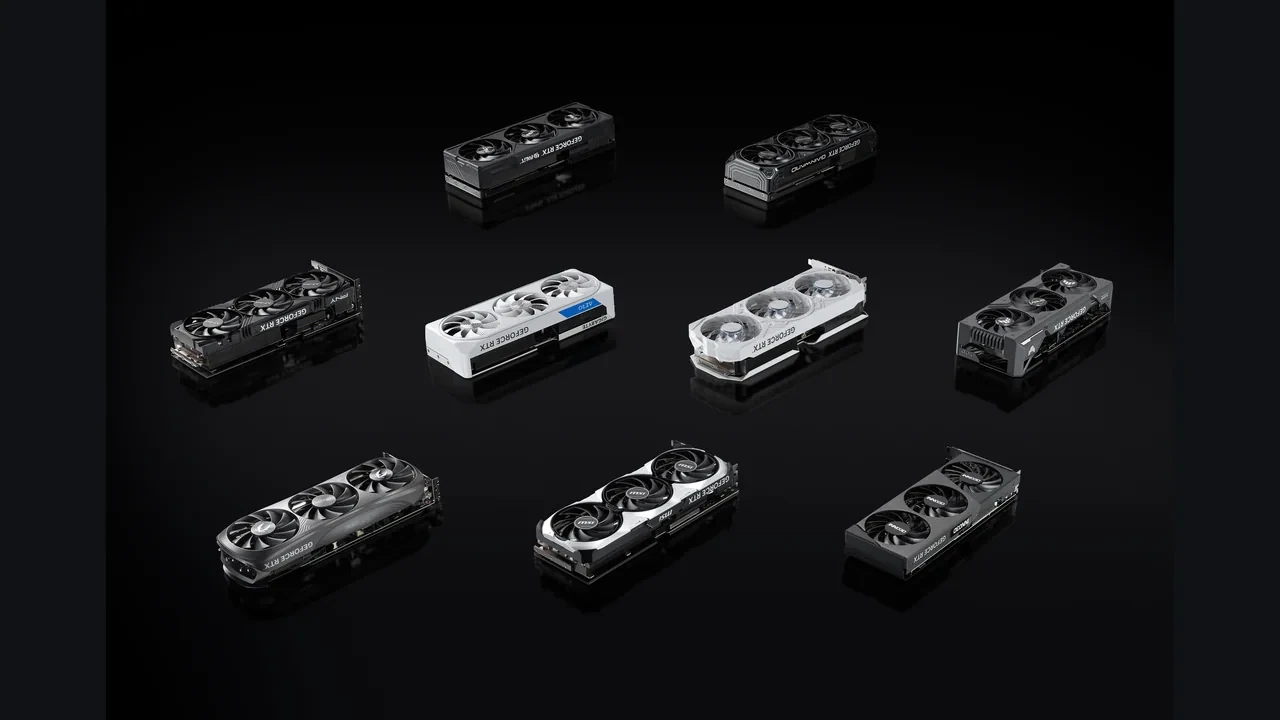

GeForce RTX 4070 Ti SUPER DLSS 5 compatibility for game developers
No official DLSS 5 launch support has been announced for the desktop GeForce RTX 4070 Ti SUPER, and later support remains unknown. A studio that needs predictable behaviour should target DLSS 4.5 Super Resolution, Ray Reconstruction, and Frame Generation. Keep DLSS 5 as a separate compatibility item to revisit when NVIDIA publishes model-specific hardware tables.
That decision keeps profiling, QA, store copy, and patch notes tied to software the card officially runs today.
What compatibility means on an RTX 40 desktop card
For a studio, compatibility means a released build can request a DLSS path on a particular GPU and receive a stable runtime response. The result depends on the linked SDK, the entry point called by the engine, and the player’s exact model.
The RTX 4070 Ti SUPER is an Ada Lovelace desktop part. Current shipping drivers expose the DLSS 4.5 stack on it. NVIDIA discusses DLSS 5 separately on its research site, but has not announced this model as supported.
Check at the model level rather than making a family-wide claim. RTX 40 products have different optical-flow hardware generations, VRAM capacities, and Tensor Core revisions. Saying either “DLSS 5 works on RTX 40” or “DLSS 5 never works on RTX 40” goes beyond the public evidence.
Where compatibility discussions go wrong
Driver exposure and project readiness are different questions. NVIDIA decides whether the driver reports a DLSS 5 entry point. The studio decides whether its engine, assets, and validation suite behave correctly after that entry point appears.
A modded DLL, forum report, or leaked benchmark may show that a library loads. It does not prove NVIDIA support, optimisation, or QA coverage, so it does not belong on a store page.
Launch support also differs from possible later support. The RTX 4070 Ti SUPER currently has no announced launch support, while future support is unknown. That answer can change between profiling and release, which is why the build should query the runtime.
DLSS 4.5 and DLSS 5 in a shipping build
DLSS 4.5 provides three runtime paths. Super Resolution reconstructs a larger output from a lower internal render. Ray Reconstruction replaces hand-written ray-tracing denoisers with a learned model and can reduce required sample counts. Frame Generation uses optical-flow data to insert an interpolated frame.
NVIDIA presents DLSS 5 as a newer family with its own compatibility profile. It will probably share the same SDK tree, so record the SDK build in the manifest and log the feature path used at runtime. On the RTX 4070 Ti SUPER, the validated path is still DLSS 4.5.
Reading NVIDIA’s launch source correctly
The public launch brief is at research.nvidia.com/labs/adlr/DLSS5. It provides NVIDIA’s feature framing and launch context, but it does not enumerate every compatible GPU.
Use the research page for context, then use SDK and driver release notes for binding support tables. If those sources differ, the driver and SDK notes decide engineering behaviour.
The card’s place in the Ada generation
The GeForce RTX 4070 Ti SUPER belongs to the Ada Lovelace RTX 40 series. The RTX 40 series Wikipedia entry is a neutral reference for model position and the relationship between desktop and laptop products, not a substitute for NVIDIA’s compatibility documentation.
VRAM, CUDA core count, and power envelope affect which DLSS 4.5 presets fit a frame budget. They do not predict DLSS 5 support.
Keep three compatibility records
One short internal document can hold the engineering status, test coverage, and public wording, but each needs its own section.
Engineering support matrix
For every feature and GPU, record whether it is supported, whether it defaults on, and what fallback runs. The current RTX 4070 Ti SUPER row shows DLSS 4.5 Super Resolution, Ray Reconstruction, and Frame Generation as supported; DLSS 5 is not officially supported, with future support unknown.
QA test matrix
List the scenes, render conditions, recorded metrics, and failure modes for each combination. Keep a DLSS 5 row marked “deferred pending official NVIDIA support” so later validation has a defined home.
Public copy matrix
Store descriptions, patch notes, and known issues must match the engineering matrix. If engineering says DLSS 5 is not supported on the card, publishing cannot imply otherwise.
When the card can become a DLSS 5 target
First, the SDK must expose a DLSS 5 entry point for the model. An out-of-tree integration is too expensive to maintain for a live shipping title.
Second, the driver must report a stable capability flag. An absent or incorrect flag means the vendor has not validated the route.
Third, profile a reference build matching the card’s VRAM, bandwidth, and compute profile. A path that works on 24 GB can still show artifacts on 12 GB hardware.
Finally, the publisher must accept responsibility for any incomplete compatibility row. Showing an unsupported control makes the studio responsible for its visual and performance behaviour.
Profiling DLSS 4.5 on the RTX 4070 Ti SUPER
Use measured project data rather than vendor marketing. Build a repeatable scene with deferred lighting, screen-space reflections, ray-traced reflections or global illumination at a known sample count, a heavy shadow path, and a UI overlay.
Capture a frame-time graph, not only an average. Optical-flow saturation can produce spikes even when upscaling lowers average cost. For every preset, record internal and output resolution, upscaler cost, denoiser cost, Frame Generation cost, and the rest of the frame. That cost map lets the team choose a mode that stays inside budget.
A forward-support plan
The trigger is any NVIDIA SDK release note that adds the RTX 4070 Ti SUPER to a DLSS 5 support table. Once that happens, rerun the DLSS 4.5 profile with a clean driver, clean SDK build, and the new path enabled. If it passes, update store descriptions, patch notes, and known issues. Keep rollback conditions for artifacts or performance failures.
The producer owns the plan, the engineering lead writes it, and the QA lead reviews it whenever the studio qualifies a new driver or SDK.
Bind code to reported capabilities
Do not hard-code model names. Request the feature through the current SDK, read its status and the driver-reported capability, then enable it, lower quality, or disable it. Log the SDK version, driver version, GPU string, and fallback.
Today that process should report support for DLSS 4.5 and no support for DLSS 5 on the RTX 4070 Ti SUPER. If a future SDK changes the result, the same code can respond without another model-list patch.
Writing to players and publishers
“The GeForce RTX 4070 Ti SUPER supports DLSS 4.5 Super Resolution, Ray Reconstruction, and Frame Generation” is defensible. “The card will support DLSS 5 in a future update” is not, because NVIDIA has not made that promise.
The settings panel makes the same claim as the store page. Gate its DLSS 5 control on the SDK and driver capability, and hide the control when support is absent. A disabled switch still suggests that the card should support it.
Handling common support cases
When a player assumes every RTX 40 card supports DLSS 5, point to NVIDIA’s model list and explain the DLSS 4.5 features that do work. If a modded driver appears to enable DLSS 5, reproduce the issue on a stock driver before logging a compatibility defect. If someone asks when the card will receive DLSS 5, say that no official support has been announced and future support remains unknown.
Feature status by family
Revalidate this table whenever NVIDIA publishes a driver or SDK.
| DLSS feature family | Current shipping version | Status on GeForce RTX 4070 Ti SUPER | Player-facing language |
|---|---|---|---|
| Super Resolution (upscaling) | DLSS 4.5 | Officially supported on RTX 40 desktop | Supported on this card |
| Ray Reconstruction | DLSS 4.5 | Officially supported on RTX 40 desktop | Supported on this card |
| Frame Generation | DLSS 4.5 | Officially supported on RTX 40 desktop | Supported on this card |
| DLSS 5 (newer feature family) | DLSS 5 launch build | No official DLSS 5 launch support announced; future support unknown | Not currently announced for this card |
One row per feature family is easier to maintain than a sprawling compatibility sheet.
DLSS 4.5 QA template
Adapt these representative scenes to the shipped game and judge them against the studio’s frame-time budget, not a marketing FPS figure.
| Scene profile | DLSS 4.5 paths enabled | Internal render resolution | Measured output | Pass criterion |
|---|---|---|---|---|
| Indoor corridor with ray-traced reflections | Super Resolution Quality, Ray Reconstruction | 2560×1440 internal, 3840×2160 output | Frame time budget, visual diff baseline | Frame time under budget, no new artifacts vs. reference |
| Outdoor daylight with heavy shadow path | Super Resolution Performance, Frame Generation | 1920×1080 internal, 3840×2160 output | Frame time budget, frame-time spike log | Frame time under budget, no spikes above budget |
| Cutscene with cinematic camera | Super Resolution Balanced | 2560×1440 internal, 3840×2160 output | Frame time budget, visual diff baseline | Frame time under budget, no temporal instability |
| Multiplayer combat arena with effects | Super Resolution Performance, Frame Generation | 1920×1080 internal, 2560×1440 output | Frame time budget, frame-time spike log | Frame time under budget, no player-visible hitches |
The committed frame-time budget is the test contract; DLSS is one way to meet it.
Related studio context
The two linked site resources provide wider production context, including how development companies structure work and how 3D cinematic content affects visual-quality and frame-time tradeoffs.
Frequently asked questions
Does the GeForce RTX 4070 Ti SUPER support DLSS 5?
No official launch support has been announced, and future support is unknown. Treat the feature as unsupported until NVIDIA publishes a model-specific entry.
Which DLSS version is officially supported?
DLSS 4.5, including Super Resolution, Ray Reconstruction, and Frame Generation.
Where is the official DLSS 5 source?
NVIDIA’s research page at research.nvidia.com/labs/adlr/DLSS5 provides the launch brief. Per-model support belongs in the accompanying SDK and driver notes.
Can the studio show a DLSS 5 toggle?
Only if the SDK and driver report support. Otherwise hide it and use the DLSS 4.5 fallback.
Will a future driver add DLSS 5?
NVIDIA has not said. Keep the forward-support plan until a release adds the card or closes the question.
How should store copy and patch notes describe support?
Use the compatibility matrix. State that DLSS 4.5 is supported and DLSS 5 is not currently announced for this model.
Is the GeForce RTX 4070 Ti SUPER a laptop or desktop part?
It is a desktop part. Do not transfer its power limits, thermals, frame budgets, or quality presets to laptop, Max-Q, or Mobile models.
How do DLSS 4.5 and DLSS 5 relate in a build?
They are different feature families sharing SDK infrastructure. A future SDK may expose both without forcing a rewrite of the existing DLSS 4.5 path.
How do launch support and future support differ?
Launch support is verifiable on release day. Future support is an unconfirmed planning possibility until a later driver or SDK names the card.
What should QA record?
Record the SDK, driver, exact GPU string, active features, internal and output resolutions, frame-time graph, and visual comparison with the reference scene.
Leave a Reply