
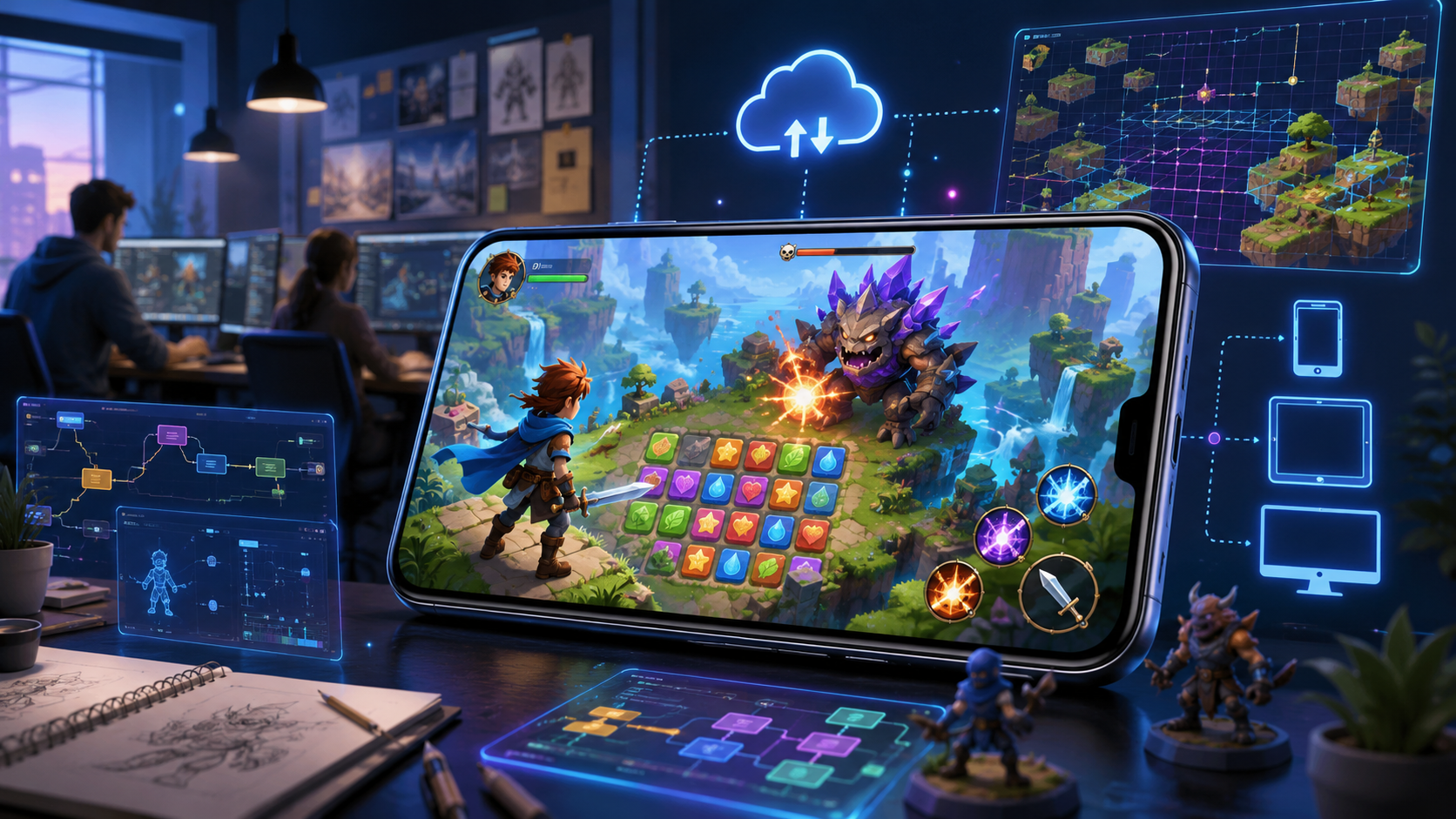

Open a mobile game in 2026 and something feels different. Not always dramatically different. There may still be gems, coins, daily rewards, colorful buttons, and that suspiciously convenient offer that expires in 14 minutes. But underneath all of that, mobile games are changing.
Players expect more now. A game has to load quickly, make sense without a 20-minute tutorial, look good on a phone, respect short play sessions, and somehow remain interesting three months later. Oh, and people increasingly expect their progress, friends, events, and communities to follow them rather than disappear when they switch devices.
That’s a lot to ask from something we may play while standing in line for coffee.
For developers, publishers, and any mobile game development company working with the U.S. market, this has changed the basic question. It is no longer simply, “Can we make a fun mobile game?” The harder question is, “Can we make something people still care about after the first week?”
And that’s where 2026 gets interesting.
The Download Is No Longer the Big Win
For years, mobile gaming was obsessed with installs. Get the ad in front of enough people, convince them to tap the button, celebrate the download.
Except a download doesn’t mean much if the player deletes the game before dinner.
The attention has shifted toward what happens after installation. Does the first session feel good? Does the player understand what to do? Is there a reason to return tomorrow? Does the game become more interesting over time instead of simply more expensive?
This sounds obvious, but it changes how games are built. Developers have to think about the first five minutes and the fiftieth hour at the same time.
| What players notice | What’s happening behind the scenes | Why it matters |
|---|---|---|
| A faster start | Shorter onboarding and fewer early menus | Players reach the actual game sooner |
| Regular new events | Live content planning | The game has reasons to feel fresh |
| More social features | Community systems and multiplayer tools | Friends can become part of the reason to return |
| Smoother progress | Better balancing and player-data analysis | Difficulty feels less random |
| Frequent small updates | Ongoing live operations | Problems can be fixed without rebuilding the whole game |
This is one reason established mobile games can stay around for years. They are not really finished products anymore. They’re closer to restaurants with permanent menus and rotating specials. The kitchen stays open, but something keeps changing.
Short Sessions Are Getting Deeper
Mobile gaming has a strange job. It has to fit into five spare minutes while still giving people enough depth to care about it for months.
That’s harder than it sounds.
A console game can reasonably expect someone to sit down for an hour. A phone game may get opened on a bus, during lunch, before bed, or while someone waits for their kid to finish soccer practice. The player might leave after three minutes because real life happened.
Good mobile design accounts for that.
A session can be short without making the whole game shallow. You might complete one puzzle in two minutes while slowly building a town over several weeks. You may fight one quick battle while improving a character across an entire season.
That’s why hybrid formats have become so attractive. They mix the instant appeal of casual games with progression systems normally associated with deeper genres.
The result? You understand the basic idea quickly, but there’s still something waiting behind the next door.
What a time-friendly mobile game usually gets right
- It gets you into actual gameplay quickly instead of burying the opening under menus.
- It gives you something meaningful to finish during a short session.
- It lets you stop without feeling that you ruined your progress.
- It saves progress reliably and makes returning easy.
- It introduces new systems gradually instead of throwing everything at you on day one.
That last point matters more than it seems. Nobody wants to open a new game and immediately meet twelve currencies, four stores, three event passes, a clan menu, a pet system, a crafting tree, and an animated wizard asking for your credit card.
Give us a minute.
Mobile Games Are Becoming Places to Hang Out
Not every mobile player wants multiplayer. Plenty of people would happily solve puzzles alone forever.
But social play has grown beyond the old idea of simply adding a leaderboard.
Modern games can turn into small digital neighborhoods. Players join groups, send items, compare progress, build things together, compete in temporary events, share creations, or simply chat between rounds.
And sometimes the social part becomes more important than the original game.
Think about why people return to the same coffee shop. Yes, maybe the coffee is good. But eventually you know the room, the staff, the music, perhaps even the person who always sits near the window.
Games can work the same way.
A mobile game development company planning a long-term title therefore has to think beyond mechanics. The team may also need systems for friendships, moderation, community events, reporting tools, player-created content, and safe interaction.
That doesn’t mean every puzzle game needs to become a social network. Please, no. Sometimes we just want to match three blue objects in peace.
The point is choice. Social features work best when they add another layer rather than block the basic game.
Live Events Have Changed the Rhythm of Gaming
Remember when buying a game meant getting the game?
Mobile gaming helped make ongoing updates normal. Now a title can have weekend challenges, seasonal maps, limited characters, anniversary rewards, collaborations, community goals, and rotating game modes.
This approach is commonly called live operations, or live ops.
The idea itself is simple: instead of releasing a game and moving on, the team keeps operating it as an evolving service.
For players, this can be great. A familiar game gets something new without requiring a sequel. But there is a fine line here.
Too little activity and the game feels abandoned. Too much and playing starts to resemble checking a work inbox.
“Log in now.” “Claim this.” “Only four hours left.” “Your team needs you.”
At some point, come on. We have laundry.
The stronger live-service games understand that missing Tuesday should not feel like missing your mortgage payment. Events create energy, but healthy design leaves room to step away.
AI Is Showing Up, but Not Quite How the Hype Suggested
Artificial intelligence is part of game development in 2026, but its role is more practical than some early predictions suggested.
Game development contains enormous amounts of repetitive work. Testing menus. Checking different screen sizes. Sorting player feedback. Creating early concepts. Producing variations of basic assets. Finding unusual bugs. Preparing content for different languages.
AI-assisted tools can speed up parts of that work.
But making tasks faster and making a game good are two very different things.
A funny character is not funny because an algorithm produced 400 dialogue options. A battle feels satisfying because timing, animation, sound, difficulty, feedback, and dozens of tiny design decisions happen to click together.
That human part remains stubbornly important.
This is especially relevant for a mobile game development company working on original intellectual property. AI may help a team test possibilities faster, but someone still has to decide which possibilities are worth keeping.
Where AI-assisted tools can fit naturally
- Early concept exploration and rough prototypes.
- Quality assurance and repetitive testing tasks.
- Localization support followed by human review.
- Sorting large volumes of player feedback.
- Helping teams study balancing problems and unusual player behavior.
- Producing internal variations during the design process.
The key word there is “support.”
Players are remarkably good at noticing when a game feels generic. Beautiful art doesn’t fix an empty loop. Endless generated dialogue doesn’t automatically create a character anyone cares about.
Technology can speed up the workshop. It cannot decide what deserves to leave the workshop.
Your Phone Is Still the Center, but the Walls Are Moving
Here’s another shift: “mobile game” doesn’t always mean “game that exists only on a phone.”
Players increasingly move between devices. Someone might play a few rounds on a phone during the day and continue on a larger screen later. Accounts, cloud saves, controllers, tablets, PCs, and other devices are slowly becoming pieces of the same gaming life.
This changes development decisions.
A tiny button that works on a six-inch screen may look ridiculous on a monitor. A control system designed for touch may feel awkward with a mouse. A game that runs beautifully on a new flagship phone may struggle on an older budget model.
Cross-platform development therefore isn’t just a matter of making the same build open everywhere.
| Design area | Phone-first approach | Cross-device challenge |
|---|---|---|
| Controls | Tap, swipe, drag | May also need mouse, keyboard, or controller support |
| Interface | Designed for a small screen | Must remain comfortable on tablets and larger displays |
| Sessions | Often short and interruptible | Players may expect longer sessions elsewhere |
| Progress | Stored around one mobile account | Needs dependable syncing between devices |
| Performance | Built around phone hardware | Has to adapt to a wider range of hardware |
Done well, players barely notice the technical work. That’s usually the sign that the technical work was good.
Monetization Is Still Here, but Players Are Less Patient
Free-to-play didn’t disappear. Neither did ads, subscriptions, battle passes, cosmetic items, starter packs, or in-app purchases.
What has changed is player awareness.
People know the tricks now.
They recognize when progress suddenly becomes painfully slow. They know when an “exclusive” deal is basically a permanent pop-up. They notice when five currencies exist mainly to make prices harder to understand.
And yes, they definitely notice when the close button on an ad is approximately the size of a breadcrumb.
Monetization itself isn’t automatically bad. A game needs revenue if a team is expected to maintain servers, create updates, pay artists, test new versions, answer support tickets, and keep the whole thing running.
The friction begins when spending stops feeling optional.
Games tend to feel fairer when players understand what they are buying. Cosmetics, convenience, expansions, optional subscriptions, and clearly explained passes are easier to judge than systems built around confusion.
There is also a basic trust issue. If someone enjoys a game, paying a few dollars can feel perfectly reasonable. If someone feels cornered, even 99 cents can feel annoying.
The First Five Minutes Matter More Than Ever
Imagine downloading a game because its video looked fun. You open it.
First comes a privacy screen.
Then an account request.
Then another download.
Then three tutorial panels.
Then a daily reward.
Then a store offer.
Then another tutorial.
Where’s the game?
This is why onboarding has become such an important part of mobile design. Players arrive with almost no commitment. They didn’t drive to a store or spend $70. They tapped a button.
Leaving is equally easy.
A strong opening answers three questions quickly: What am I doing? Why is it fun? What happens if I keep playing?
The explanation doesn’t need to be long. In fact, it usually shouldn’t be.
Good mobile games teach through action. Tap this. Great. Something happened. Try this next. Now you’ve already learned more than five paragraphs of tutorial text could explain.
Vertical Games Make More Sense Than They Used To
Landscape mode once felt like the obvious choice for anything remotely serious. Turn the phone sideways and, boom, now we’re gaming.
That assumption has softened.
Portrait games fit naturally into the way people already hold phones. They are easy to open with one hand and less awkward during brief sessions.
Does portrait mode work for everything? Of course not. Nobody is begging for a complicated racing simulator squeezed into a narrow strip.
But puzzles, card games, idle games, strategy hybrids, word games, and many casual formats can feel perfectly comfortable vertically.
The interesting part isn’t the orientation itself. It’s the idea behind it: mobile games no longer need to imitate consoles to feel legitimate.
A phone is its own gaming device. Design can start there.
Accessibility Is Becoming Part of Good Design
Accessibility isn’t a bonus menu that teams should think about three days before launch.
Small text, low contrast, tiny touch targets, audio-only information, fast reaction requirements, and confusing icons can make an otherwise good game frustrating for a lot of people.
And accessibility features often help everyone.
Subtitles help someone playing without headphones. Adjustable text helps a person holding the phone farther away. Clear visual feedback helps in a noisy airport. Simplified controls may help someone with limited mobility and also the parent attempting to play while holding a sandwich in the other hand.
Real life is messy like that.
Teams thinking about accessibility early generally have more room to design around it rather than patch it in later.
People Want Games That Respect Their Time
This may be the biggest theme of 2026.
There are too many things competing for attention. Streaming, social apps, podcasts, work messages, group chats, short videos, sports, books, and, occasionally, actual human beings sitting in the same room.
A mobile game cannot simply demand attention. It has to earn it.
That doesn’t necessarily mean games must become shorter. Some people happily spend hours playing on a phone. The difference is control.
A player should feel that they’re deciding when to play, rather than responding to a stream of artificial emergencies.
Before keeping a new mobile game, ask yourself
- Do I enjoy the actual gameplay, or am I mostly collecting rewards?
- Can I skip a day without feeling punished?
- Are purchases easy to understand?
- Does the game respect my notifications and attention?
- Can I play comfortably without spending more than I planned?
- Would I still open it if the daily reward disappeared?
That last question is surprisingly useful.
What This Means for a Mobile Game Development Company
Building a mobile game in 2026 involves far more than coding a mechanic and adding some artwork around it.
A mobile game development company may have to think about gameplay, onboarding, device performance, analytics, live content, community systems, accessibility, privacy, monetization, customer support, localization, security, store presentation, and future updates before the game has even launched.
And every extra system adds another place where something can go wrong.
That’s why the smartest development decisions are sometimes surprisingly boring.
Make the core game work first.
If moving, tapping, solving, building, racing, fighting, or whatever the player actually does isn’t satisfying, a giant seasonal roadmap will not save it.
You can’t decorate your way out of a weak game loop.
The same principle applies when a business is looking for a mobile game development company. A large feature list sounds impressive, but the more useful questions are practical ones. How will the game be tested? What happens after launch? How will older devices be handled? Who owns the code and assets? How are updates managed? What happens if the player base suddenly grows?
The glamorous part is the trailer. The less glamorous parts are what keep the trailer from advertising a disaster.
FAQ
What does a mobile game development company do?
A mobile game development company can handle game design, programming, art, testing, backend systems, monetization, publishing preparation, and post-launch updates. The exact work depends on the studio and project.
Are mobile games still popular in the United States in 2026?
Yes. Mobile remains a major part of gaming because phones are already part of everyday life. The format also covers everything from two-minute puzzle sessions to deep strategy and multiplayer games.
Is AI replacing mobile game developers?
No. AI can assist with specific production tasks, testing, analysis, concepts, and other repetitive work, but game direction, judgment, balancing, storytelling, art direction, and player experience still need substantial human input.
Why do mobile games receive so many updates?
Many modern games operate continuously after release. Updates may add events, characters, levels, fixes, balancing changes, seasonal content, or technical improvements.
Can a mobile game also work on PC?
Yes, depending on how it is built. Cross-device games can share accounts and progress, although controls, interfaces, performance, and screen layouts often need extra work.
Why are some mobile games free?
Free-to-play games usually earn money through advertising, optional purchases, subscriptions, passes, cosmetics, or a mix of several models. A free download lowers the barrier for someone who simply wants to try the game.
What makes a good mobile game in 2026?
There is no single formula, but good games usually start quickly, make their basic mechanics clear, run reliably, respect the player’s time, and provide a reason to return that goes beyond constant rewards or spending prompts.
Conclusion: The Best Mobile Games Know When to Get Out of the Way
Mobile gaming in 2026 is becoming more ambitious and, strangely enough, more aware of its limitations.
A phone isn’t a console squeezed into your pocket. It is something you check dozens of times during a normal day. Games that understand that rhythm can fit into life remarkably well.
They start quickly. They let us leave. They remember where we were. They give us something interesting when we return.
Behind that apparently simple experience is a surprising amount of work. A mobile game development company now has to think far beyond graphics and code. Live updates, communities, multiple devices, AI-assisted production, monetization, accessibility, performance, and long-term player relationships can all become part of the same project.
Still, none of those trends changes the oldest rule in gaming.
The game has to be fun.
Not “engaging” according to a dashboard. Not impossible to stop because eight reward systems are blinking at once. Actually fun.
Because after the AI tools, social features, seasonal events, cross-device accounts, analytics, and fancy shop screens are stripped away, there is still one person holding a phone and asking a very simple question:
Do I want to play one more round?
If the answer is yes, the developers probably got the important part right.
Leave a Reply